How Does Termidor Termite Treatment Work?
Termidor works by creating an invisible treated zone in the soil that termites can’t detect or avoid. As they tunnel through, they contact fipronil, pick it up on their bodies, and carry it back to the colony. There, they spread it through grooming and contact, silently killing workers and the queen. You can use liquid around foundations or foam inside walls, and you’ll see how it wipes out colonies and protects your home long-term as you go further.
Key Takeaways
- Termidor uses fipronil, a non-repellent termiticide, so termites pass through treated soil without detecting it and pick up a lethal dose.
- It creates a continuous treated zone around a structure’s foundation, applied by trenching, drilling, and coarse perimeter sprays.
- Exposed termites transfer fipronil to nestmates through contact and grooming, spreading the toxin throughout the colony.
- Fipronil disrupts termite nerve function by blocking key chloride channels, causing overexcitation, paralysis, and death.
- The treatment starts killing termites immediately and typically eliminates colonies in 30–90 days, with residual protection lasting up to 10 years.
What Is Termidor and When Should You Use It?
Termidor is a professional-grade termiticide from BASF that uses the active ingredient Fipronil to quietly eliminate termites and protect structures for years. You’re using America’s leading termite control product, with more than 4 million structures treated since 2000. Termidor SC Termiticide/Insecticide is 100% effective against termites in three months or less, delivering truly unparalleled termite control.]
It’s non-repellent, so termites don’t detect it and continue to move through treated soil, ensuring thorough coverage around your home or building.
You can choose from several formulations—Termidor HE (High Efficiency), Termidor SC (Suspended Concentrate), and Termidor Foam—depending on the site and application needs.
Use Termidor when you’ve got active termite activity in or around a structure, or when you want to protect new or existing buildings. It’s ideal for creating a treated zone along foundations and around areas prone to infestation, such as fences, telephone poles, decks, and other wooden timbers.
It’s effective against common subterranean termites and aggressive invasive species around properties.
How Termidor’s Fipronil Ingredient Kills Termites
While you know Termidor is a powerful, non-repellent defense against termites, its real strength comes from how its active ingredient, fipronil, attacks the insects’ nervous system.
Fipronil, a phenylpyrazole insecticide, blocks key GABA- and glutamate-gated chloride channels in a termite’s central nervous system. When those channels shut down, chloride ions can’t flow properly, nerves fire uncontrollably, and the termite’s muscles overexcite until it dies. Because the Environmental Protection Agency regulates how termiticides like fipronil are used, professional application helps ensure both effectiveness and safety around your home.
Fipronil disrupts termite nerve signals, triggering lethal muscle overexcitation and rapid colony-wide collapse
You don’t just get a few dead foragers. Fipronil works fast and thoroughly inside the colony. Termites exposed to even 1–3 ppm can’t survive beyond five days, and field studies show entire structural infestations disappearing within about 90 days.
- Fipronil causes rapid initial mortality from direct soil contact
- Low-dose exposure still leads to complete kill within days
- Labeled applications have achieved 100% elimination in treated structures
- Both interior and exterior treatments show full clearance by the third month
Why Termidor’s Non-Repellent Design Is So Effective

Because its non-repellent formula stays completely undetectable to termites, they move through Termidor-treated soil as if nothing’s there, picking up the active ingredient with every step. They can’t see, smell, taste, or avoid it, so they tunnel freely through treated zones that would stop them cold if you’d used a repellent product like bifenthrin or permethrin. In fact, field trials have shown that a single Termidor treatment can provide protection for up to ten years, giving homeowners long-term peace of mind without frequent reapplications.
With repellents, termites sense the barrier and simply skirt around it, leaving hidden entry points to your home. Termidor solves that avoidance problem and starts protecting you from Day 1, without the waiting period you get with bait systems.
Here’s how Termidor’s design stacks up:
| Feature | Repellent Products | Termidor Non-Repellent |
|---|---|---|
| Termite reaction | Detect and avoid | Tunnel through confidently |
| Soil barrier performance | Gaps and bypassing | Continuous hidden exposure |
| Speed of protection | Immediate but avoidable | Day 1, unavoidable contact |
| Long-term reliability | More retreatments | Proven multi-year control |
The “Transfer Effect”: How Termidor Reaches the Entire Termite Colony
Once termites start moving through Termidor-treated soil and pick up tiny amounts of fipronil, the real power of the product kicks in through what’s called the “Transfer Effect.” Instead of dropping dead right away, exposed termites keep foraging, interacting, and grooming their nestmates as usual, all while carrying a microscopic payload of active ingredient on their bodies.
Because Termidor’s non-repellent, termites don’t avoid it; they repeatedly tunnel through three-dimensional treated zones, contacting treated soil particles and even dragging them back into their galleries. Backed by over eight years of research, this proven performance has been shown to deliver 100% control in three months or less.
- Fipronil’s slow action means termites show no sickness for hours, so they continue normal movement, digging, and communication.
- Constant grooming spreads fipronil efficiently; nearly half of what an exposed termite carries can move to a nestmate.
- Primary, secondary, and tertiary termites all receive doses through repeated contact chains.
- Multiple foraging entry points into treated soil help the Transfer Effect reach deeply hidden termites, driving thorough colony collapse.
Termidor Foam vs Liquid: Which Works Best Where?
When you’re choosing between Termidor foam and liquid, you need to match each product to the job you’re trying to accomplish.
You’ll see that foam shines for targeted spot treatments inside walls and other tight spaces, while liquid works best as a long-lasting perimeter shield around your home. Termidor Foam is a ready-to-use formulation that requires no mixing, making it especially convenient for quick, precise applications.
In many cases, you’ll get the strongest protection by combining foam and liquid so you hit both active infestations and future invasions.
Best Uses For Foam
Two Termidor formulations—foam and liquid—do very different jobs, and using each in the right place makes the treatment far more effective.
You use Termidor Foam when termites or carpenter ants are already inside structural elements and you need precision, not perimeter protection. The expanding foam pushes deep into wall voids, kick holes, and hidden galleries, reaching colony cores liquid can’t touch.
It’s especially useful where you see clear activity—bubbling paint, hollow wood, or frass—but can’t physically access the nest.
- Inject into cracks, crevices, and voids behind drywall and between studs
- Flood galleries in crawl spaces, foundations, and visible nests
- Treat termite kick holes to drive foam into hidden tunnels
- Knock down active colonies fast, then follow with broader treatments
Ideal Situations For Liquid
Foam shines inside walls and hidden voids, but liquid Termidor does the heavy lifting anywhere soil meets the structure. You’ll rely on it most for full perimeter treatments, where trenching and soil saturation create a continuous Termidor Treatment Zone around foundations, patios, and porches.
This zone stops subterranean termites of all U.S. species as they tunnel in or out.
Use liquid when you want long-term, low-maintenance protection. It binds tightly to soil, resists rain and irrigation, and stays effective for up to 10 years with inspections.
Because termites can’t detect it, they move through treated soil, pick up fipronil, and spread it deep into the colony. It’s ideal when you need proven, 100% control in about three months.
Combining Foam And Liquid
Although Termidor Foam and liquid Termidor use the same powerful active ingredient, each excels in different parts of a termite job—and you get the best results by using them together.
You rely on liquid to lock termites out by creating a long‑lasting soil barrier around foundations. Then you use foam to hunt down the termites already inside walls, voids, and wooden elements.
- Use foam in wall voids, drywall holes, crawl spaces, and fencing where liquid can’t reach.
- Inject foam through kick‑out holes to expand through galleries and contact hidden termites.
- Rely on liquid outdoors for continuous protection; use foam indoors for precise spot work.
- Combine both so foam crushes active pockets quickly while liquid stops reinfestation.
How Termidor Is Applied Around Your Home
When a professional applies Termidor around your home, they create a continuous treated zone in the soil and on key exterior surfaces so termites and other pests can’t approach unnoticed.
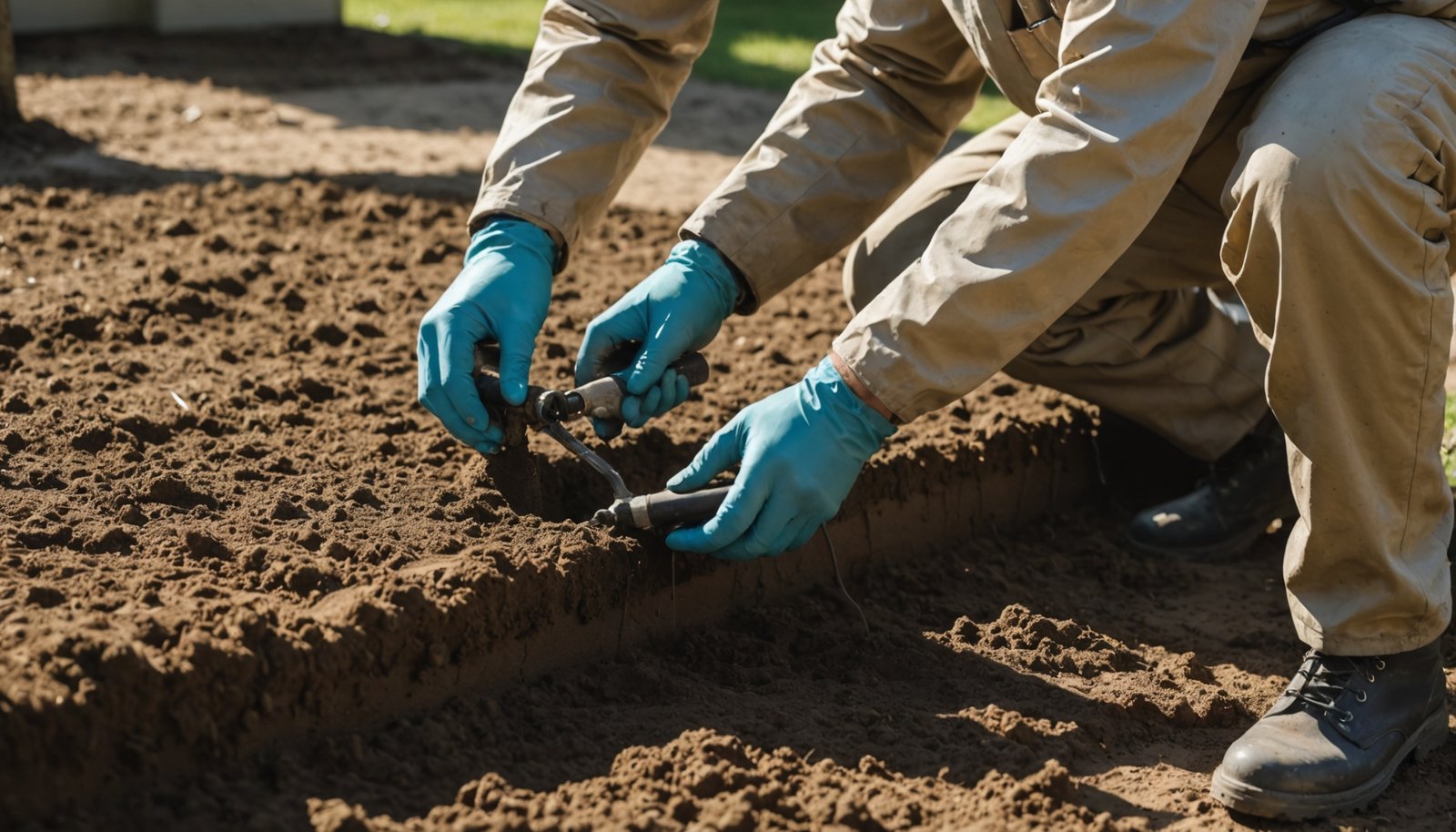
They usually start by trenching 6 inches wide and 6 inches deep right against the foundation, then applying about 4 gallons of finished Termidor solution for every 10 linear feet. They replace and pack the soil so the termiticide binds evenly throughout that zone.
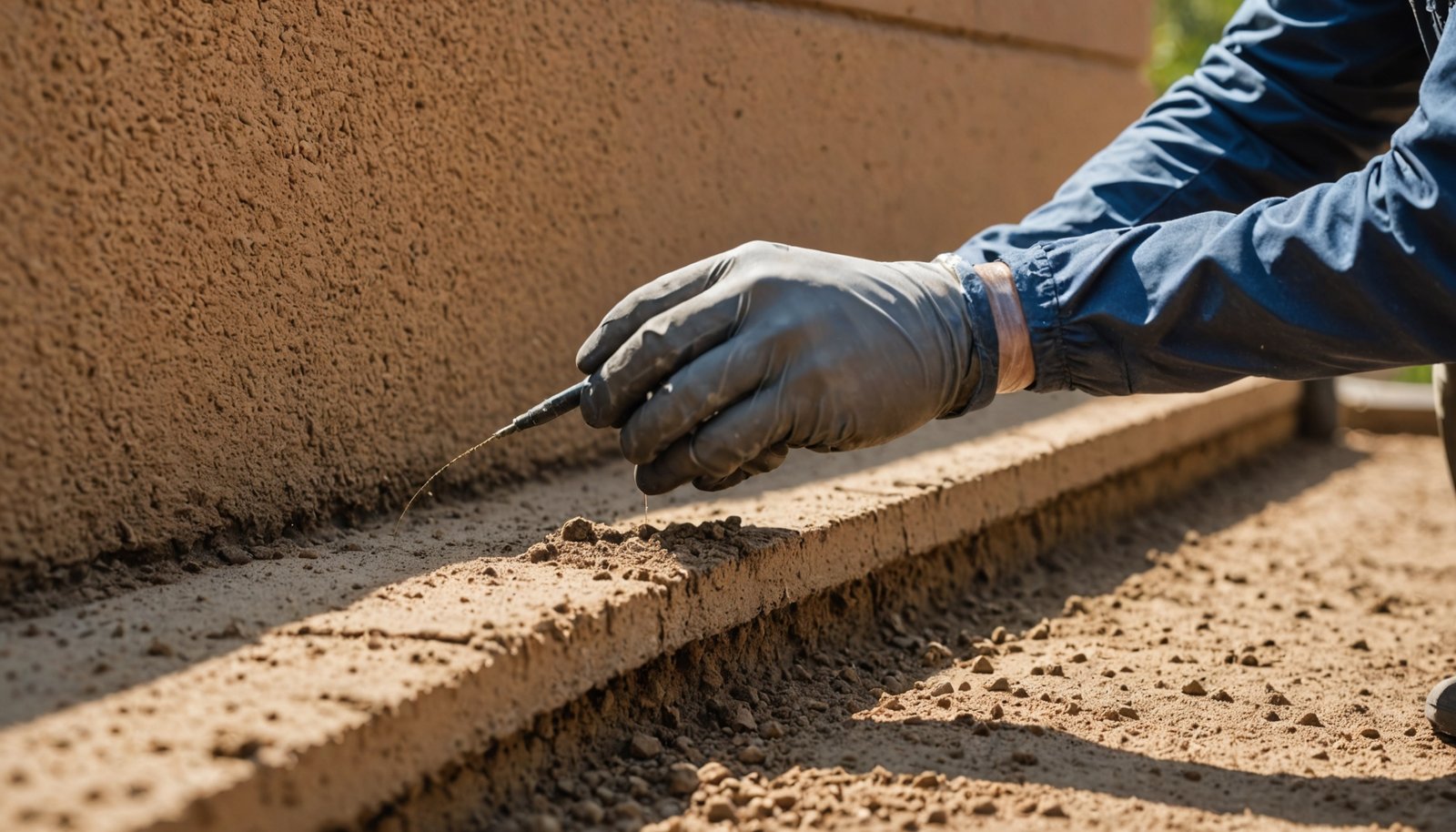
Where concrete, patios, or driveways meet the foundation, they’ll drill small holes and inject Termidor with high-pressure rods. This pushes the solution to the depths where subterranean termites tunnel, maintaining an unbroken underground shield.
Next, they apply a low‑pressure, coarse spray band around doors, windows, vents, and utility lines—about 1 foot up the wall and 1 foot out on the ground.
Mixed and agitated to the correct strength, this exterior band stops ants and other perimeter pests before they reach your home.
Is Termidor Safe for People, Pets, and the Environment?
As you picture that treated zone around your foundation, it’s natural to ask how Termidor affects your family, pets, and the environment. In normal use, it’s classified as slightly toxic if swallowed, inhaled, or absorbed through skin, with high LD50 values in animal testing.
It can irritate eyes and skin, so licensed applicators wear gloves and goggles and keep the product locked away from children.
For pets, Termidor’s low acute toxicity and lack of skin sensitization in studies suggest it’s safe when you follow label directions and keep animals away during application and drying.
Overexposure could still cause tremors, lethargy, or breathing issues, so a vet visit and monitoring are critical in suspected ingestion.
Environmentally, you must treat Termidor with caution.
- It’s highly toxic to fish and aquatic invertebrates.
- Never allow runoff into ponds or streams.
- Don’t apply to saturated or frozen soil.
- Use backflow-prevention when mixing.
How Fast Termidor Works and How Long It Lasts
Even though Termidor doesn’t knock termites down instantly, it works quickly at the colony level and keeps protecting your home for years.
Termidor works fast at the colony level and keeps your home protected from termites for years
Once termites tunnel through the treated soil, they pick up fipronil on their bodies and ingest it with normal feeding. Because Termidor is slow‑acting and non‑repellent, they keep moving, grooming, and feeding, quietly spreading it throughout the colony.
You start seeing serious impact fast. Field tests show Termidor manages colonies in three months or less and delivers 100% control in that time.
In some situations, the chemical barrier can wipe out a colony in as little as 30 days. Compared with bait systems, it acts about 2–6 times faster.
Termidor’s real strength is how long it lasts. Over nine years of data show 100% effectiveness, with no reported treatment failures, across all major U.S. termite species, soil types, and climates, protecting millions of homes since 2000.
Should You DIY Termidor Treatment or Hire a Pro?
Termidor’s speed and staying power only pay off if you apply it correctly, which raises a big question: should you tackle termite treatment yourself or bring in a licensed pro.
When you go DIY, you’re usually limited to repellent or contact-kill products. They may knock down visible termites but don’t create the undetectable “transfer effect” Termidor’s known for, so the colony survives.
Misidentifying termites, missing hidden galleries, or leaving gaps in coverage lets them keep eating.
By contrast, licensed professionals can actually use Termidor at full strength and apply it with the right rigs for deep, continuous soil barriers. They also inspect for hidden activity and tailor treatment to your home.
- DIY costs look lower upfront but often lead to repeated buys and costly repairs.
- OTC chemicals can be hazardous when misapplied.
- Termites easily bypass poorly applied treatments.
- Professional warranties and monitoring protect your long-term investment.
Conclusion
When you understand how Termidor works, you can see why it’s one of the most trusted termite treatments available. Its stealthy, slow-acting design wipes out colonies at the source while keeping your home off their menu long-term. Whether you choose foam, liquid, or both, you’re building a powerful barrier that keeps working for years. Partner with a licensed pro, and you’ll protect your biggest investment before termites even have a chance to do damage.