

How to Treat Termites in Wood Furniture Yourself
To treat termites in wood furniture yourself, start by tapping surfaces to detect hollow spots and checking for frass, pinholes, or discarded wings. Strip any finish from affected areas, then apply a borate-based treatment like Bora-Care using a brush or injector syringe directly into drilled holes. Orange oil works fast but fades quickly, while borate sprays offer lasting protection. There’s a lot more to know about doing this right.
Key Takeaways
- Inspect furniture for hollow sounds, frass, pinholes, discarded wings, soft spots, and musty odors before beginning any treatment.
- Wear protective gear, then apply orange oil for fast-acting contact kill or borate sprays for long-term residual protection.
- Strip all finishes from wood surfaces before applying Bora-Care via spray or brush until the wood reaches full saturation.
- Drill small holes in a diamond pattern to inject borate directly into hidden termite galleries, treating unreachable infested areas.
- After confirming termite inactivity, fill holes with epoxy or wood hardener, sand flush, and refinish with protective coats.
How to Tell If Your Furniture Has Termites
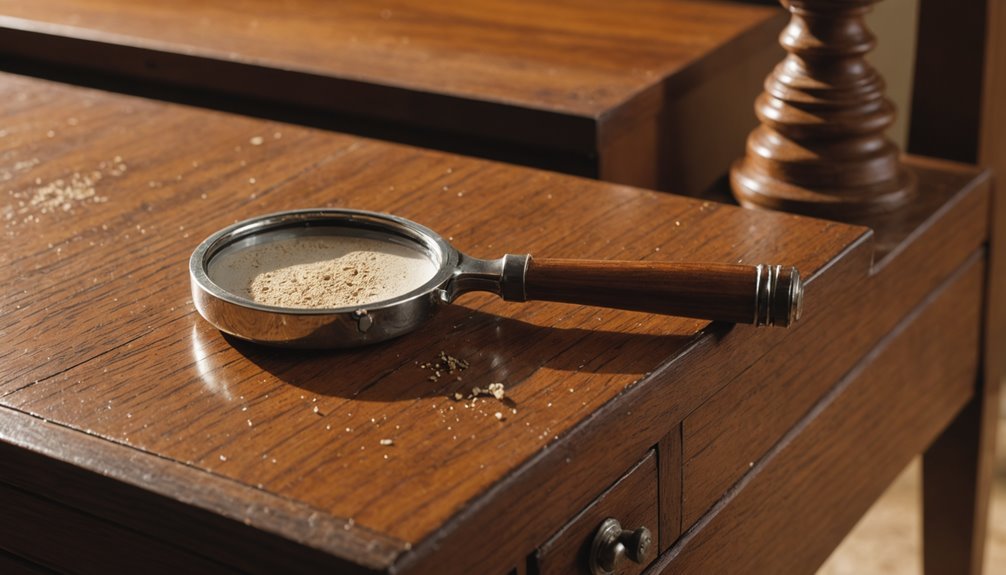
Knowing whether your furniture has termites can save you from costly damage down the line. Start by tapping on wood surfaces — a hollow sound often means termites have eaten through the inside while leaving the outer shell intact.
Look for tiny pinholes, maze-like tunnels, rippled surfaces, or sunken areas where internal feeding has occurred.
Check under furniture, inside drawers, and on horizontal surfaces for frass — small, dry pellets resembling sawdust that drywood termites leave behind. Discarded wings near furniture or windows signal a recent swarm.
You might also notice soft spots, weakened legs, or musty odors. Bubbling or peeling paint can indicate damage beneath a coated surface.
None of these signs alone confirms an infestation, but multiple signs together warrant immediate attention. Subterranean termites may also leave mud tubes along walls or furniture legs as they travel from the soil to reach wood.
Which Parts of Infested Furniture to Inspect First
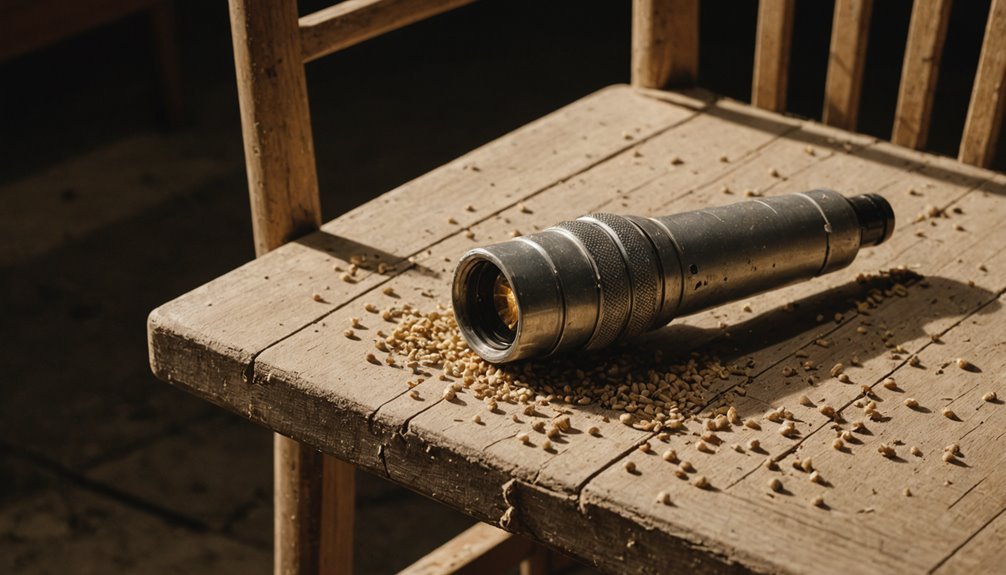
When you suspect a termite infestation, knowing where to look first can make the difference between catching it early and missing it entirely.
Start with the legs, side panels, back panel, and tabletop edges, since these exposed surfaces show damage first. Run a tap test across multiple spots and listen for hollow sounds that signal internal tunneling.
Next, flip the piece and inspect the underside frame, support rails, and bottom panels. Search for frass, exit holes, and crumbling wood in these load-bearing sections.
Open every drawer and cabinet door to check interior corners, shelf edges, and hidden compartments for pellet piles or soft spots.
Finally, inspect the floor beneath, nearby baseboards, and surrounding walls, since termites rarely stay confined to a single piece. Secondhand furniture sourced from humid environments carries a significantly higher risk of harboring hidden termite activity before it ever enters your home.
Tools and Supplies You Need Before Treating Termites
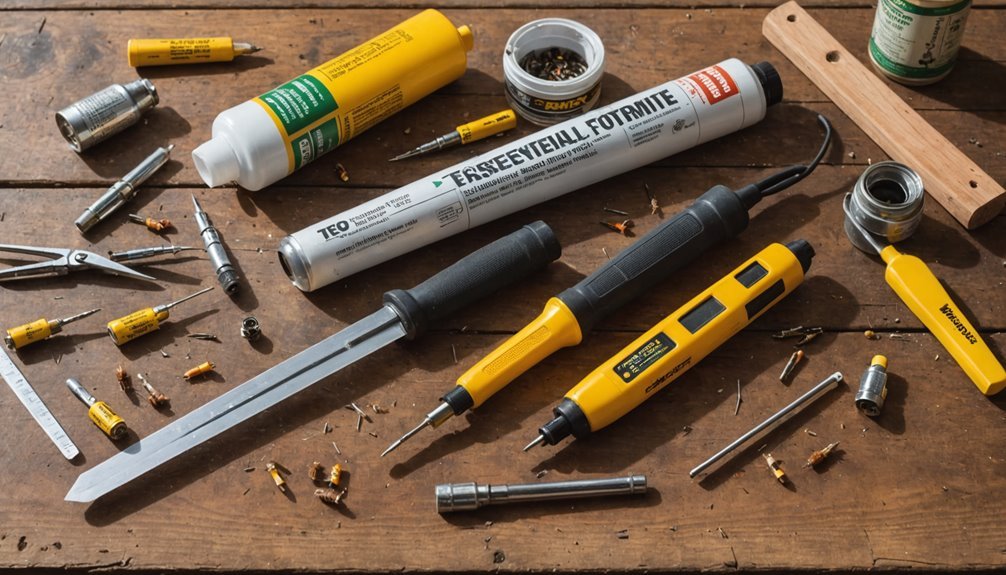
Before you start treating termites in your wood furniture, you’ll need to gather the right tools and supplies to do the job effectively and safely.
On the treatment side, you’ll want a termite injector or syringe, a ready-to-use termiticide, and a borate-based product for surface application on unfinished wood.
You’ll also need protective gear—gloves, safety glasses, and a respirator mask—to shield yourself from chemical exposure during injection and surface treatment. After treatment, use scotch tape or similar to seal the kick-out holes you injected.
Essential Treatment Supplies
Treating termites in wood furniture requires 5 categories of supplies you’ll want to gather before starting any work.
Having everything ready saves time and keeps your treatment effective from start to finish.
Here’s what each category covers:
- Treatment products – borate-based solutions like Bora-Care, orange oil, or drywood termite insecticides matched to your specific termite species
- Application tools – a drill, termite injector, hand-pump sprayer, foaming device, and vacuum
- Hole-sealing materials – wood putty, epoxy filler, or wood patch compatible with sanding and refinishing
- Inspection supplies – a flashlight, tape for marking active kick-out holes, and a small drill bit
- Cleanup and monitoring items – drop cloths, trash bags, a monitoring checklist, and a camera for follow-up documentation
When using borate-based products like Bora-Care, always mix with hot water in a 5-gallon bucket to prevent clogging during application.
Protective Gear Required
Gathering your treatment supplies is only half the preparation—you’ll also need the right protective gear before handling any termiticide.
Wear chemical-resistant gloves, tucking them into your sleeves to protect your wrists. Put on long sleeves, long pants, and closed-toe footwear with socks to block splashes and drips. Tightly woven fabrics offer better protection than worn or loosely woven clothing.
Protect your eyes with safety goggles or glasses that provide wide front, side, and brow coverage. Add a face shield if splash risk increases during mixing.
In enclosed spaces like attics or crawl spaces, wear a respirator suited to the termiticide you’re using—ventilation alone isn’t enough.
After treatment, launder contaminated clothing separately and wash your hands thoroughly with soap and water. Many termiticides are highly toxic to humans, so carefully following label instructions is essential to protecting yourself throughout the process.
How Orange Oil, Boric Acid, and Borate Sprays Compare
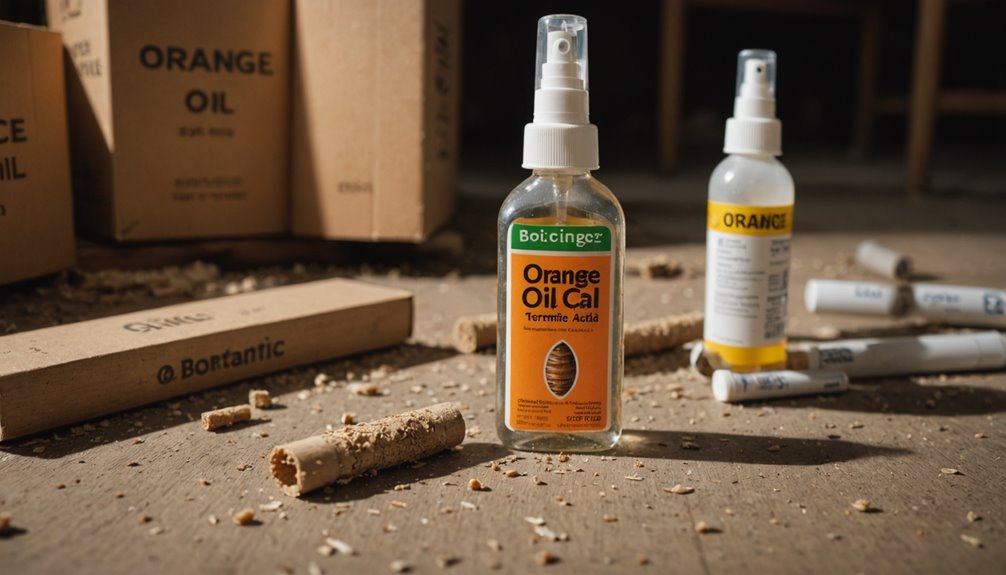
When treating termites in wood furniture, you’ll likely come across three common options: orange oil, boric acid, and borate sprays.
Each works differently—orange oil’s active compound, d-Limonene, kills termites on contact but loses effectiveness within 2 to 3 days, while boric acid dehydrates and disables termites that ingest it.
Borate sprays like Bora-Care inhibit digestive enzymes to starve them from the inside out.
Understanding how these products compare in effectiveness and best use cases helps you choose the right treatment for your specific furniture problem.
How Each Product Works
Each of these products kills termites through a different mechanism, so understanding how they work helps you choose the right one for your situation.
Here’s a quick breakdown:
- Orange oil kills on contact by breaking down the termite’s waxy outer layer, causing dehydration and death.
- Boric acid acts as a stomach poison, disrupting digestion and nutrient absorption after termites ingest or groom it off treated surfaces.
- Borate sprays penetrate wood fibers and poison termites as they feed or tunnel through treated lumber.
- Residual activity varies greatly — orange oil fades within 3–7 days, while borates offer longer-lasting wood protection.
Orange oil works fastest but only where it directly contacts termites.
Boric acid and borate sprays rely on termite behavior to deliver the toxic dose.
Effectiveness Rates Compared
Choosing the right treatment means understanding how these products actually perform against termites.
Orange oil has the clearest kill-rate data available, but even under ideal lab conditions, it only reaches 77% termite mortality — meaning it won’t eliminate an entire colony. It’s contact-kill only, so it works best on localized drywood infestations where you can reach the galleries directly.
Its residual effect also fades within 3–8 days, limiting long-term protection.
Boric acid works more slowly but suits broader or preventive applications. Borate sprays focus on wood protection and residual value rather than rapid knockdown.
Neither has published kill-rate statistics that match orange oil’s lab data. For severe or hidden infestations, you’ll likely need to combine these treatments rather than rely on any single product.
Best Uses Per Product
All three products — orange oil, boric acid, and borate sprays — solve different problems, so matching the right one to your situation matters more than picking a favorite.
Here’s a quick breakdown:
- Orange oil works best when you’ve confirmed a localized drywood termite infestation and can drill directly into every gallery.
- Boric acid fits best when you want slow-acting, low-toxicity control on bare, unfinished wood after identifying a problem.
- Borate sprays are your strongest option for preventive treatment on unpainted, unsealed wood surfaces before infestation takes hold.
- Borate-based products outlast orange oil for long-term protection since orange oil’s residual activity fades within 3–8 days.
If you can’t access the infested galleries directly, skip orange oil entirely and go borate-based.
How to Use Borate Treatments on Infested Wood
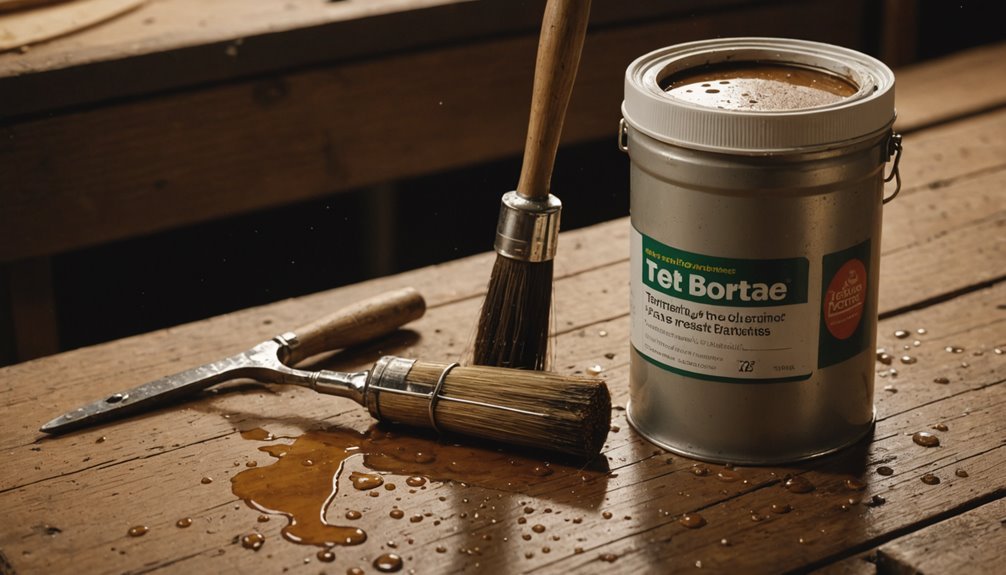
Before applying, strip any finish, stain, or sealant from the surface. Borates can’t penetrate coated wood, so bare, clean, and dry surfaces are essential.
Mix Bora-Care according to label directions, then spray, brush, or roll it onto all exposed wood until the surface reaches saturation.
For galleries you can’t reach directly, drill 7/64″ to 1/8″ injection holes in a diamond pattern and treat beyond the visible damage zone.
Let the wood dry at least 48 hours before finishing, and seal it within six weeks.
How to Drill Into Wood and Treat Hidden Galleries
Before you drill, inspect the furniture closely for frass deposits, kickout holes, and hollow-sounding sections to map where the galleries likely run.
Once you’ve identified a target area, drill 1/8- to 1/4-inch holes spaced about 4 inches apart, pushing the bit until it loses resistance, which signals you’ve reached a gallery.
After injecting foam or liquid termiticide through each hole until material exits adjacent openings, seal the holes with wood putty or a matching filler to restore the surface.
Locating Termite Entry Holes
Finding termite entry holes is where your treatment effort starts, and knowing what to look for saves you from drilling blindly into good wood.
Flip the piece over and use a flashlight to scan joints, undersides, and interior drawer surfaces first.
Watch for these specific indicators:
- Small round holes or pinholes along joints and edges
- Frass resembling sawdust or dry coffee grounds near openings
- Kick-out holes where drywood termites expel frass near hidden galleries
- Discarded wings near the furniture or surrounding light sources
Once you’ve spotted suspect areas, tap across the surface to find hollow sections.
Then probe soft spots with a screwdriver to confirm internal galleries before marking your drill points.
Drilling Into Wood Galleries
If you can’t pinpoint the galleries precisely, expand into a checkerboard pattern across the affected section.
Keep holes shallow when the void is near the surface; you only need to reach the tunnel, not drill through the entire piece.
Once you’ve confirmed gallery access, inject your termiticide, foam, or borate dust directly into the hole.
Apply until the product returns through the hole or appears at adjacent openings.
Filling Holes After Treatment
Once the termiticide, foam, or borate dust is in place, don’t rush to patch the holes. Confirm termites are inactive first—sealing active galleries traps surviving insects inside.
Choose your filler based on damage scope:
- Wood hardener for small holes and weakened fibers
- Epoxy putty or wood filler for larger, deeper voids
- Liquid epoxy for hidden galleries and narrow tunnels
- Epoxy consolidant to stabilize friable fibers before layering filler
Press filler firmly with a putty knife, angling it to reach irregular edges and eliminate air pockets.
Apply multiple coats if the material sinks into porous wood. Once fully cured, sand the patch flush, then stain or paint to blend the repair with the surrounding surface.
How Sunlight and Heat Can Kill Termites in Small Furniture
One surprisingly simple way to treat termites in small furniture is moving the piece into direct sunlight for two to three days.
Direct sunlight kills termites through heat and UV exposure, which dehydrates their bodies and dries out shelter tubes. Termites can’t survive without moisture and darkness, so prolonged sun exposure turns the furniture into a hostile environment.
Sunlight dehydrates termites and destroys their shelter tubes, stripping away the moisture and darkness they need to survive.
Aim for at least eight hours of strong daily sun, and make sure the entire piece gets exposed, not just one side.
Keep in mind that sunlight only reaches surface-level termites. Hidden colonies inside thick joints or internal cavities may survive.
Watch the furniture closely for warping or finish damage, and follow up with additional treatment if you still notice active termite activity.
Home Termite Remedies That Work: and Ones to Skip
Sunlight works well for surface-level termites, but what about the dozens of home remedies you’ll find online? Some genuinely help with small, localized activity, while others waste your time.
Remedies worth trying on visible, accessible infestations:
- Neem oil, orange oil, or clove oil — spray or inject directly into affected wood for contact killing.
- Boric acid — apply as a spray or powder to dehydrate termites in targeted spots.
- White vinegar or salt water — simple contact sprays for exposed termites only.
- Cardboard traps — useful for monitoring activity, not eliminating colonies.
Skip anything marketed as an instant cure. Single-application sprays rarely penetrate deep enough to reach hidden colonies.
Treat these remedies as first-response tools, not complete solutions.
How to Fill and Refinish Wood After Termite Treatment
After confirming the infestation is fully eradicated, you’re ready to assess the damage and begin repairs. Remove all loose, crumbly wood, then vacuum debris with a HEPA filter. Wear gloves and an N95 mask throughout cleanup.
Once the infestation is gone, remove loose wood, vacuum debris with a HEPA filter, and wear protective gear throughout.
If the wood feels mostly solid, apply wood hardener first and let it dry completely. Then press wood filler firmly into voids using a putty knife, building deeper repairs in layers to prevent sagging.
Sand everything smooth and level once cured.
If a screwdriver sinks in deeply or the wood crumbles, replacement is the better option rather than filler.
For refinishing, prime or stain only after the filler fully cures. Apply a first coat to check color, make touch-ups, then finish with one or two protective final coats.
Keep Termites From Coming Back After You Treat
Keeping termites from returning takes consistent effort across moisture control, sanitation, and structural maintenance. Fix leaks, improve ventilation, and drain water away from wood surfaces to eliminate the damp conditions termites prefer.
Remove cellulose debris, store firewood away from the home, and keep storage areas uncluttered.
Here’s what to prioritize long-term:
- Seal entry points — Fill cracks, gaps around pipes, and foundation openings with caulk or steel mesh.
- Eliminate moisture — Repair plumbing leaks and maintain gutters so water drains away from wood.
- Remove food sources — Keep cardboard, lumber scraps, and mulch away from walls and furniture.
- Schedule inspections — Arrange annual professional inspections and watch for frass, mud tubes, or hollow wood.
Act quickly if you spot new activity.
Frequently Asked Questions
Can Termites Spread From Treated Furniture to Other Wooden Items Nearby?
Yes, treated furniture can still spread termites if the treatment’s incomplete. If live termites remain inside, they’ll move to nearby wooden items, so you should inspect surrounding furniture and guarantee full eradication.
Is It Safe to Use Termite-Treated Furniture Around Children and Pets?
Yes, it’s safe once the treatment’s fully dry. Keep children and pets away during application, wipe down surfaces afterward, and ventilate the area well before allowing them near the treated furniture.
How Long Does It Take to Confirm a Termite Treatment Actually Worked?
You’ll typically need 1–2 months to confirm a termite treatment worked. Watch for no new mud tubes, frass, or live termites during follow-up inspections. Larger infestations may require up to 12 months of monitoring.
Should Infested Furniture Be Isolated From the Rest of Your Home?
Yes, you should isolate infested furniture immediately. Move it away from walls, other wooden items, and storage areas. Keep it on a non-wood surface and monitor it for frass, wings, or fresh holes during treatment.
Can Heavily Damaged Furniture Be Saved, or Does It Need Replacing?
If your furniture’s heavily hollowed, warped, or structurally broken, you’ll likely need to replace it. You can’t restore structural integrity with cosmetic fixes, and repeated treatments on severely damaged pieces usually aren’t worth the effort or cost.
Conclusion
You’ve now got everything you need to tackle termites in your wood furniture without calling in a pro. Whether you choose borate sprays, heat treatment, or orange oil, acting fast makes all the difference. Don’t forget to fill damaged wood and apply a protective finish once the treatment’s done. Stay consistent with prevention, and you won’t have to fight this battle again anytime soon.

Pingback: Do Termites Bite? What Happens If One Does - Termite Control Care