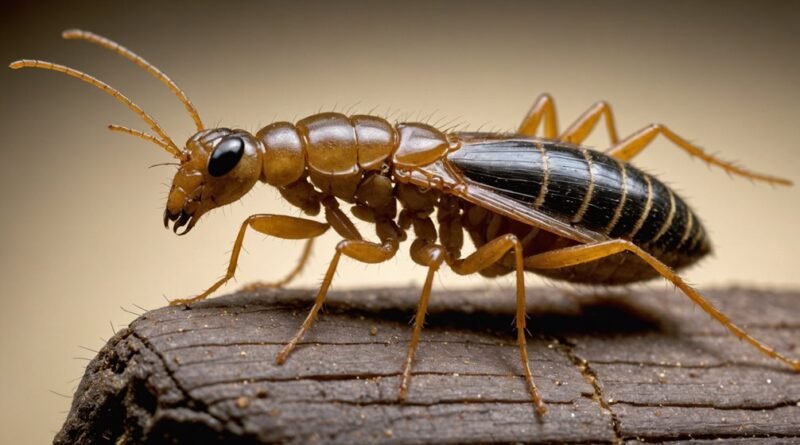
What Do Termites Look Like up Close
Up close, termites have a thick, soft body with no pinched waist, giving them a broad, uniform silhouette. Their antennae are straight and bead-like, unlike an ant’s elbowed ones. Workers appear pale or creamy-white, while swarmers are darker with four equal-length wings that stretch well past their bodies. You’ll also notice they look fragile and less armored than other insects. There’s plenty more to know that’ll help you identify them with confidence.
Key Takeaways
- Termites have soft, pale bodies with a thick, uniform shape and no pinched waist, giving them a chunky, oval silhouette.
- Their antennae are straight and bead-like, unlike the bent, elbowed antennae seen on ants.
- Workers appear pale white to gray-white, while swarmers are typically dark brown to black with translucent wings.
- Four equal-length wings extend beyond the body, appearing smoky gray or translucent, distinguishing them from flying ants.
- Up close, termites show minimal body segmentation, a soft exterior, and less visible division between thorax and abdomen.
What Does a Termite’s Body Actually Look Like?
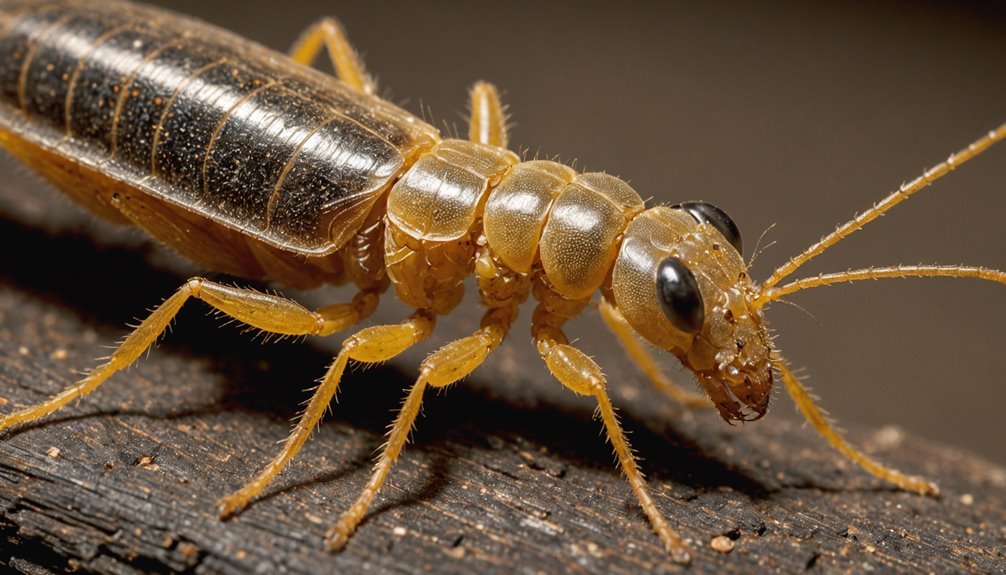
If you’ve ever spotted a termite up close, one of the first things you’ll notice is its thick, soft body with no pinched waist. Unlike ants, termites have a broad, oval-shaped profile that stays relatively uniform from head to abdomen. That straight-sided silhouette is one of the clearest visual clues you’re looking at a termite rather than something else.
You’ll also notice the body segments, though they don’t create the dramatic narrowing you’d see in an ant. The overall build looks robust and even chunky by comparison.
The soft, less-armored surface gives termites a pale, almost fragile appearance. That thick waist and soft exterior make termite body shape one of the easiest identifying features to spot, even without magnification. Their straight, bead-like antennae are another distinct feature that sets them apart from other insects at a glance.
How Big Are Termites When You See Them?
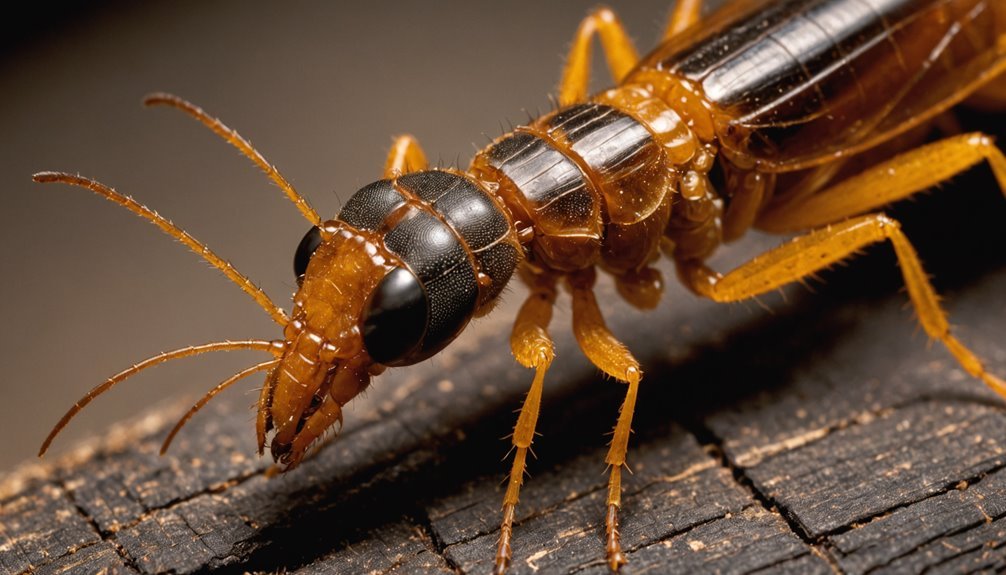
When you look at a termite up close, you’ll notice most adults measure between 1/4 inch and 1/2 inch long, though workers tend to run smaller and soldiers can appear larger due to their oversized heads.
Drywood termites reach up to an inch, while subterranean species stay closer to 1/8 to 3/8 inch, so the species and caste you’re looking at both affect what you see.
Because termites stay hidden inside wood or soil, you’ll often spot only partial bodies, making them seem even smaller than they actually are. In terms of scale, they are similar in size to small ants like grease ants, which can help you gauge what to expect when spotting one.
Typical Termite Size Range
Most termites you’ll encounter fall somewhere between 1/4 and 1/2 inch long, though many workers measure even smaller — closer to just a few millimeters.
To put that in perspective, you’re looking at roughly the size of a grain of rice, sometimes slightly longer.
The full reported range runs from about 2.54 mm to 12.7 mm for common species, with some reaching up to 25 mm.
That variation matters because termites from the same colony can look noticeably different in size. Workers tend to be the smallest, while reproductive forms — the swarmers you might see flying near windows — often reach the upper end of the range.
If you can spot one clearly without magnification, it’s likely on the larger side of what’s typical. Soldiers, which sit between workers and reproductive termites in size, typically measure 6 to 8 mm and are distinguished by their notably strong mandibles.
Caste Size Differences
What you see when you spot a termite depends heavily on its caste.
Workers are the smallest, often around 1/8 inch long, soft-bodied, and pale white to gray-white. They’re the most numerous, so they’re what you’ll most commonly encounter.
Soldiers are larger and immediately recognizable by their oversized rectangular heads and prominent mandibles. They look bulkier than workers, even though they’re still small insects overall.
Swarmers stand out most, reaching roughly 3/8 to 1/2 inch with dark bodies and two equal-sized wing pairs.
Queens can grow dramatically larger, exceeding 4.5 inches in some species. Mature queens are capable of laying up to 1,000 eggs daily at peak reproductive output.
Side-by-side comparisons make these differences clearest.
Wing presence, head size, and body bulk are your best visual cues when distinguishing one caste from another.
Spotting Small Termites
Spotting a termite in your home can be surprisingly tricky given how small these insects actually are. Most workers measure only 1/8 to 3/8 inch long, appearing as tiny pale specks unless you look closely. Their cream-colored bodies blend easily into wood and soil surfaces.
Three things that help you identify what you’re seeing:
- Size range — termites typically fall between 3 mm and 1 inch depending on species and caste.
- Wings — swarmers appear larger because wings add visible length, making them easier to spot near windowsills and light sources.
- Shed wings — roughly 1/4 inch long, these are often more visible than the termite itself.
If movement is slow and the body is soft and elongated, you’re likely looking at a termite. Termite larvae are even harder to notice, measuring just 1/10 inch long and appearing nearly invisible to the naked eye.
How Do You Tell a Termite Apart From an Ant?
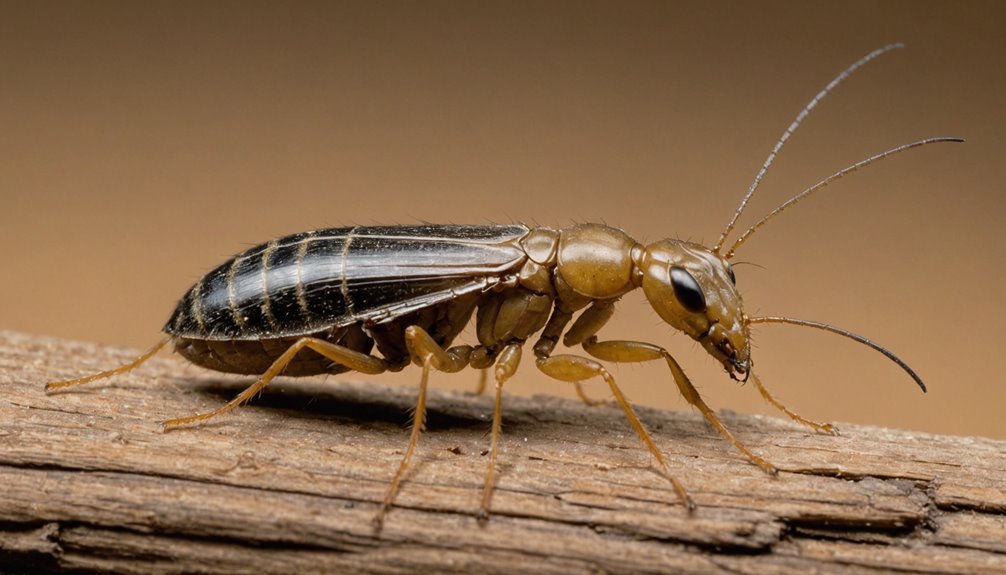
At a glance, termites and ants can look almost identical, but a few key physical traits set them apart quickly.
Start with the waist. Ants have a narrow, pinched waist between the thorax and abdomen, while termites have a thick, straight, tube-like body with little to no visible waist.
Next, check the antennae. Ant antennae are bent and elbowed, while termite antennae are straight and bead-like.
If you’re looking at swarmers, compare the wings. Termites have four wings of equal length, often longer than their body. Ants have a longer front pair and a shorter hind pair.
Finally, termite workers tend to be pale or creamy-white, while ants are usually brown, reddish-brown, or black.
Why Termites Look Different Depending on Their Role
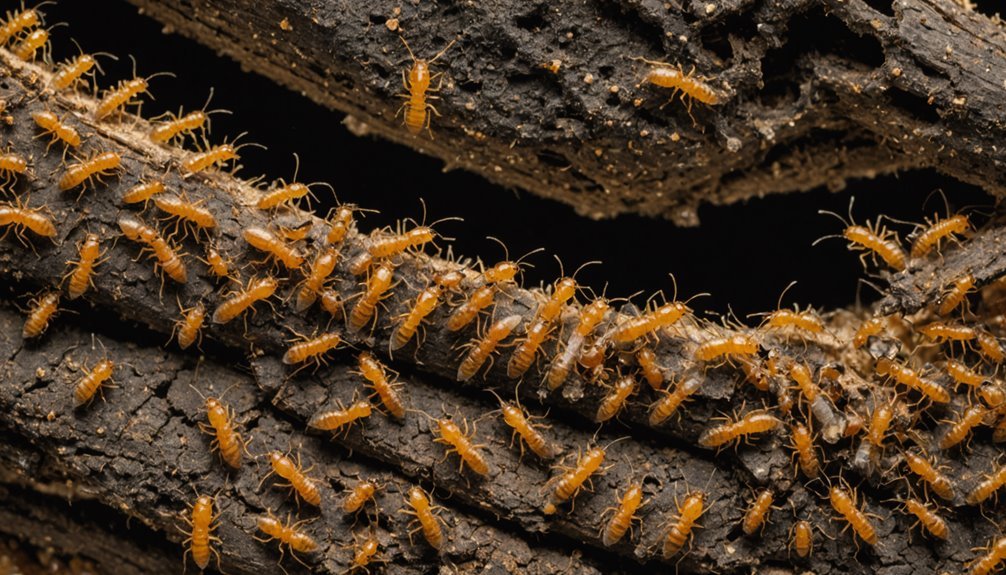
Once you can tell a termite from an ant, the next thing that might throw you off is how different termites within the same colony can look from one another.
Spotting a termite is one thing — realizing they barely look alike within the same colony is another challenge entirely.
Caste determines everything about their appearance, and the differences are striking.
Here’s what each caste looks like:
- Workers – Pale white or creamy yellow, soft-bodied, often wingless and eyeless from living inside tunnels.
- Soldiers – Dark reddish-brown or orange heads, visibly enlarged with big mandibles built for defense.
- Reproductives – Dark brown to black, winged, and noticeably larger than the others.
Same colony, wildly different appearances.
Knowing which caste you’re looking at helps you understand the infestation’s size and activity level.
What Do Termite Antennae and Waists Actually Look Like?
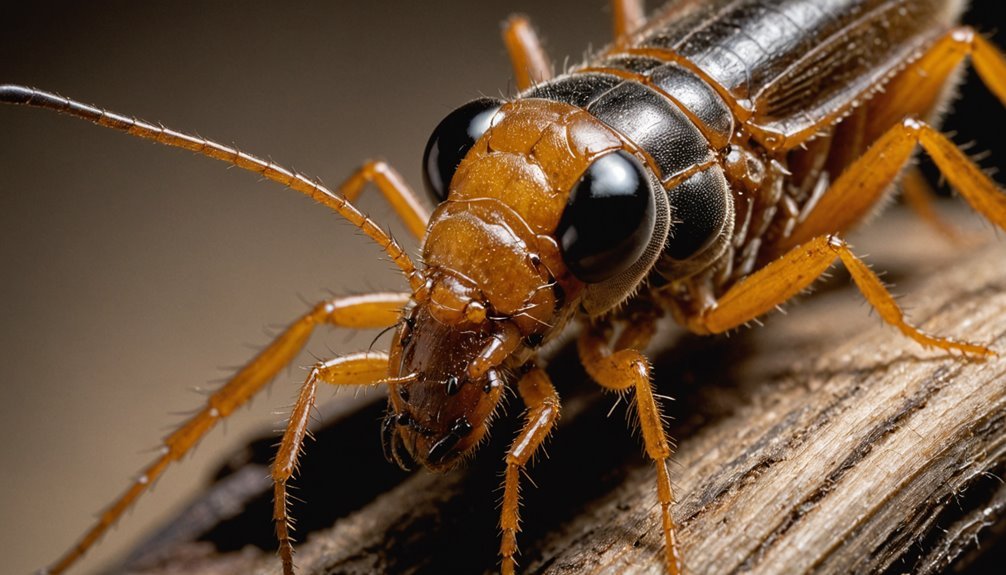
Two features separate termites from ants faster than anything else: antennae shape and waist shape.
When you look closely at a termite, you’ll notice its antennae are straight and bead-like, with no sharp bend or elbow. Ant antennae angle sharply midway — termite antennae don’t.
The waist tells a similar story. Termites have a thick, uniform body connection with no visible narrowing between the thorax and abdomen. Ants pinch noticeably at the waist; termites don’t.
Together, these two traits give termites a smoother, more continuous silhouette.
If you’re examining a close-up photo or a live insect and you’re unsure what you’re looking at, check the antennae and waist first. Those two features will point you toward the right answer faster than color or size ever will.
What Do Winged Termites Look Like Up Close?
When you spot a winged termite up close, you’ll notice its two pairs of wings are equal in size, translucent or smoky gray, and extend well beyond the body.
Unlike flying ants, the termite’s body stays thick and uniform, with no pinched waist breaking up its cylindrical shape.
Color-wise, you’re likely looking at a light yellow-brown to dark brown insect with a soft, non-glossy surface that lacks the hard-shelled look of beetles or ants.
Wings and Body Shape
If you spot a winged termite up close, one of its most recognizable features is its four equal-length wings. Two wings sit on each side, and they’re often longer than the body itself.
Flying ants have longer front wings, so equal length is your clearest distinction.
The body shape is just as telling. Termites have a thick, straight waist with no pinching between the thorax and abdomen, giving them a tube-like, uniform appearance.
Look for these three features together:
- Four wings of equal length held flat over the back
- A straight, thick waist with no narrowing
- A soft-looking, compact body with less visible segmentation
Spotting all three confirms you’re looking at a winged termite rather than a flying ant.
Swarmer Color Traits
Color is one of the first things you’ll notice when looking at a swarmer termite up close. Most swarmers appear dark brown to black, though some species lean toward tan, yellowish-brown, or pale yellow.
Formosan swarmers tend to look yellowish-brown, while drywood swarmers can range from light yellow to nearly black. Eastern subterranean swarmers may fall anywhere from pale cream to black.
The body typically looks uniform in color across the head, thorax, and abdomen, with a soft rather than glossy appearance. Freshly emerged swarmers may look paler before darkening.
Wings often appear smoky gray or translucent with visible veins.
Color alone won’t confirm a termite ID since winged ants share similar tones. Pair color with straight antennae, even wing length, and a non-pinched waist.
Signs of Termite Damage You Might Notice First
Termite damage often shows up in ways you mightn’t immediately connect to insects. Before you see a single termite, your home may already be giving you clues.
Watch for these early warning signs:
- Hollow-sounding wood – Tap baseboards or framing. A hollow thud means termites may have eaten the interior while leaving the outer shell intact.
- Warped doors and floors – Buckling floors or frames that suddenly stick can signal lost structural support from feeding activity beneath the surface.
- Bubbling or peeling paint – Blistered paint, tiny pinholes in drywall, or sunken wall surfaces often indicate hidden galleries forming underneath.
You might also notice discarded wings near windows or a musty scent, both linked to active infestations.
Mud Tubes, Frass, and Other Close-Up Signs of Termites
Once you know what to look for, mud tubes are one of the most telling signs of subterranean termite activity. These pencil-thin tunnels connect soil to wood and are built from soil, wood particles, and saliva.
You’ll typically find them on foundation walls, baseboards, crawl spaces, and concrete surfaces. Up close, they look like raised, gritty, crumbly lines rather than smooth streaks.
There are four main types: exploratory, working, swarming castle, and drop tubes. Fresh, intact tubes signal active infestations more strongly than old or broken ones.
Frass, on the other hand, points more toward drywood termites. Those small, hard pellets near kick-out holes can resemble sawdust or coffee grounds.
Combined with discarded wings or hollow-sounding wood, these close-up signs help you identify which termite group you’re likely dealing with.
How to Confirm a Termite Problem Before Calling a Pro
Before you call a pest control professional, it’s worth doing a hands-on check yourself to confirm whether you’re actually dealing with termites. Start by tapping suspect wood with a screwdriver—a hollow sound suggests internal feeding.
Then inspect mud tubes along your foundation and break a small section open to check for live activity.
Three key confirmation steps worth doing first:
- Recheck broken mud tubes after a few days to see if termites repaired them, which signals an active colony.
- Look for frass pellets near baseboards or windowsills, pointing to drywood termites.
- Photograph every sign—damaged wood, wings, and tubes—and map their locations before scheduling an inspection.
Multiple signs appearing near foundations or crawl spaces strengthen the case for professional treatment.
Frequently Asked Questions
Can Termites Bite Humans if Handled or Disturbed?
Yes, termites can bite you if you handle or disturb them. Soldier termites are most likely to bite since they’re built for defense. You’ll typically feel just a small pinch with minor redness.
How Long Do Termites Typically Live Compared to Other Insects?
Termites live far longer than most insects. Workers survive 1–2 years, but queens can live 15–50 years. That’s exceptional compared to flies or mosquitoes, which you’d see living only days to weeks.
Do Termites Make Any Sounds That Humans Can Hear?
Yes, you can sometimes hear termites! They produce soft clicking, tapping, rustling, and crunching sounds. You’ll detect them most easily in quiet rooms at night, near walls or wood surfaces where they’re actively feeding.
Are Termites More Active During Certain Times of Day?
You’ll find termites are most active at night, especially when it’s warm and moist. They’re typically more visible after dark near lights and windows, with spring and summer bringing the highest overall activity levels.
Can Termites Survive Outdoors in Cold Winter Temperatures?
Yes, termites can survive outdoors in cold winter temperatures. They’ll burrow deeper into soil, staying below the frost line where it’s warmer. You won’t see much activity, but colonies often remain alive and capable of feeding.
Conclusion
Now that you know what termites look like up close, you’re better equipped to spot them before they cause serious damage. You’ve learned how to distinguish workers from swarmers, identify mud tubes and frass, and tell termites apart from ants. Don’t ignore the warning signs—the sooner you act, the less destruction you’ll face. If you’re seeing any of these indicators, it’s time to call a pest control professional.