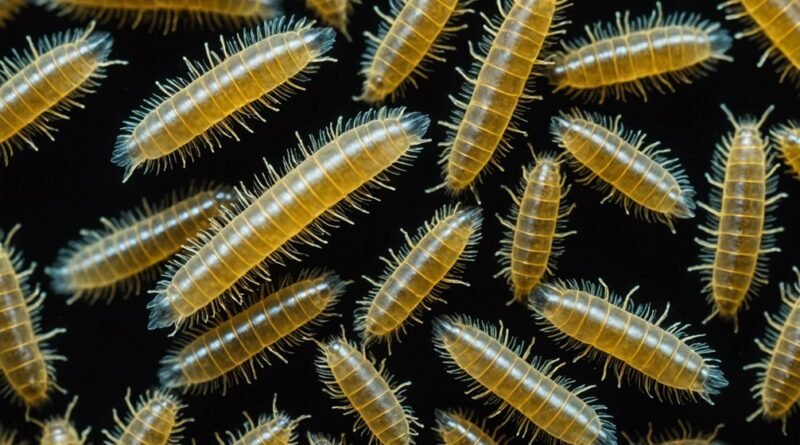
Termite Larvae Identification
Termite larvae look like tiny, pale grains of rice, measuring about 1/10 inch long with soft, cream-colored bodies. You’ll notice they have a defined head, thorax, and abdomen, though their legs and antennae are barely visible. They cluster together deep inside the colony and rely on worker termites for care. Because they’re so small, you’ll likely need magnification to spot them. There’s much more you should know before they get the upper hand.
Key Takeaways
- Termite larvae are tiny, pale white to cream-colored, and measure approximately 1/10 inch, resembling small grains of rice.
- They have a defined head, thorax, and abdomen, but legs and antennae are barely visible without magnification.
- Unlike ant larvae, termite larvae have a broad, rectangular body, straight antennae, and no pinched waist.
- Unlike legless maggots, termite larvae have six legs, a distinct head capsule, and organized body segmentation.
- Larvae typically appear in clusters deep within colonies, requiring professional identification due to their small size.
What Do Termite Larvae Actually Look Like?
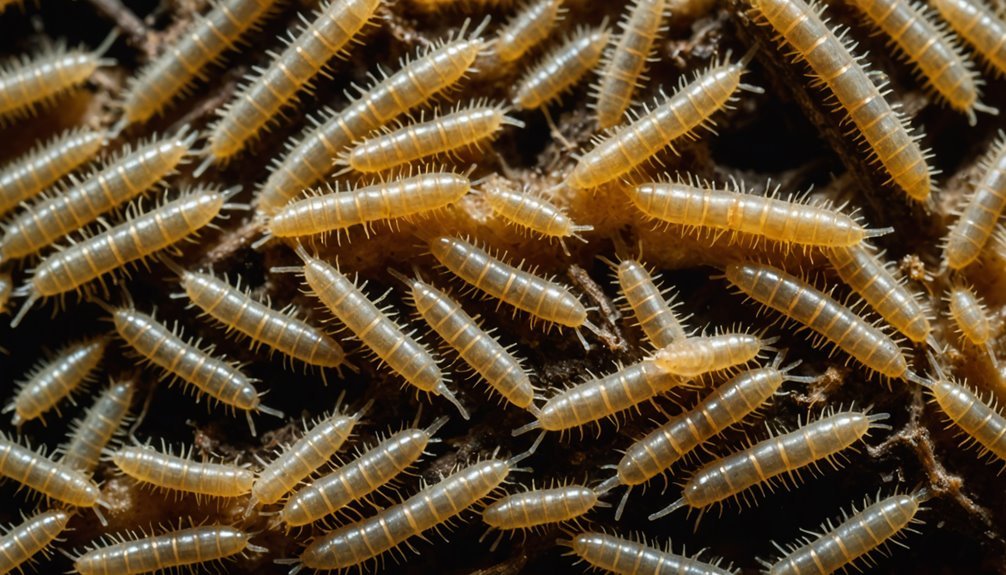
Termite larvae look like tiny, pale grains of rice — soft-bodied, white to cream-colored, and almost translucent due to their lack of body pigmentation.
Termite larvae resemble tiny grains of rice — pale, soft-bodied, and nearly translucent from their lack of pigmentation.
They’re roughly 1/10 inch long, making them easy to miss inside infested wood or nest chambers.
You’ll notice they’ve a defined head, thorax, and abdomen, but the segments appear less developed than in adult termites.
Their legs aren’t prominent, their antennae are barely visible, and their heads are small and plain — none of the darker coloring you’d see on soldiers or reproductives.
What you’re typically looking at is a softer, simpler version of a worker termite.
You’ll usually spot them in clusters rather than alone. They depend entirely on worker termites for food and care during this early stage of development.
How Big Are Termite Larvae Compared to Adult Termites?
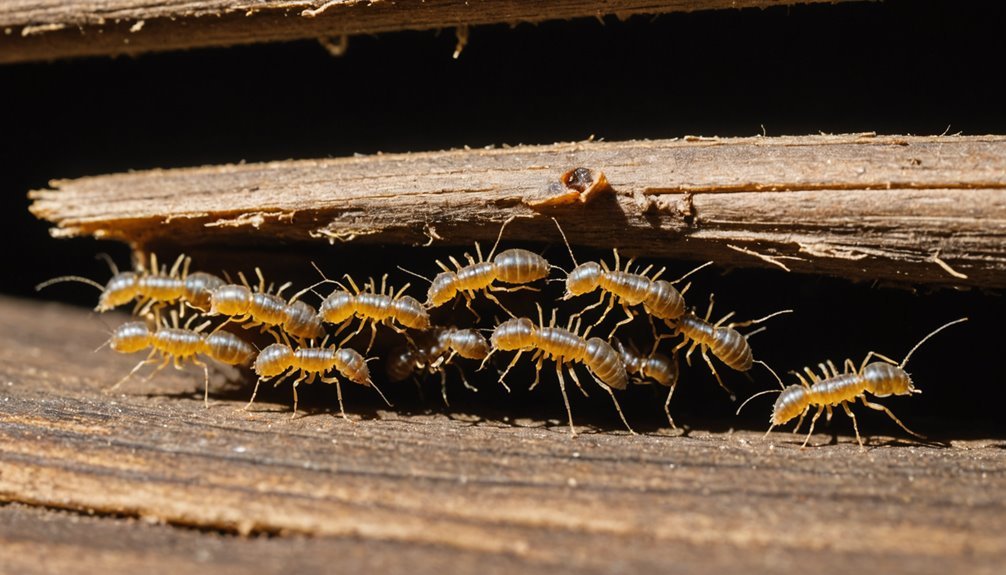
Once you know what termite larvae look like, their size becomes the next thing worth understanding. Termite larvae measure about 1/10 inch (2.5 mm), while adult termites reach 1/4 to 3/8 inch long. That small gap means you could easily miss an entire generation hiding in your walls.
Here’s what that size difference really means:
- A larva is roughly one-third the length of an adult termite you’d actually notice.
- Larvae are about the same size as the eggs they hatched from.
- Workers and soldiers you spot during an inspection are already far larger than the larvae protected deeper inside.
- A single larva is small enough to resemble debris, making early detection nearly impossible without professional help.
Different roles within the colony can affect how large a termite grows, meaning size varies by role and larvae represent the smallest end of that spectrum.
What Caste Does a Termite Larva Grow Into?
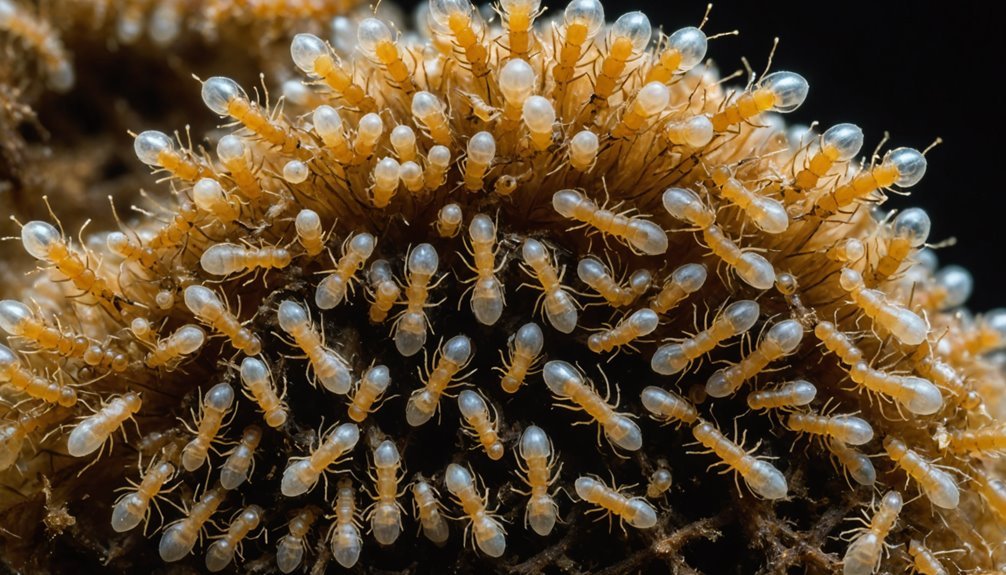
When you spot a termite larva, you can’t tell just by looking at it what caste it’ll become. A larva’s fate isn’t fixed at hatching—it can grow into a worker, soldier, or reproductive depending on the colony’s needs and biological signals like hormones and pheromones.
Understanding this developmental flexibility helps you recognize why termite larvae look so similar yet ultimately serve very different roles in the colony. Research on *Reticulitermes flavipes* has shown that this process is driven by differential gene expression, which determines whether a larva develops into a worker, soldier, or reproductive caste.
Larval Caste Determination
Whether a termite larva becomes a worker, soldier, or reproductive isn’t fixed at birth—it depends on a shifting mix of environmental cues, hormonal signals, and colony needs.
Juvenile hormone levels, worker care, nutrition, and colony composition all shape which path a larva takes. Here’s what’s actually driving that fate:
- Soldier deaths trigger pheromone signals that push workers to replace what was lost.
- Reproductive females actively suppress new reproductives from forming around them.
- Juvenile hormone surges during molting can physically transform a worker into a soldier.
- Genetic background quietly biases outcomes before any environmental signal arrives.
You’re looking at a system where no single factor decides anything—it’s a constant negotiation between the larva and its colony.
Castes Larvae Develop Into
A termite larva doesn’t stay a larva—it develops into one of three core castes: worker, soldier, or reproductive.
Workers handle feeding, grooming, nest building, and repair. Soldiers defend the colony and typically pass through a presoldier stage before their final molt. Both castes are sterile.
Reproductives take different forms. Winged alates disperse and mate, while secondary and tertiary reproductives stay in the colony without dispersing.
In many species, larvae first become nymphs, which can then shift toward winged reproductives, wingless reproductives, or worker-like forms.
Colony needs drive which caste develops. Chemical signals passed through grooming and trophallaxis regulate caste balance, and if the colony loses members of any caste, new individuals develop to fill the gap. A mature queen can lay up to 1,000 eggs daily, directly influencing how many individuals are available to develop into each caste.
Termite Larvae vs. Ant Larvae: How to Tell the Difference
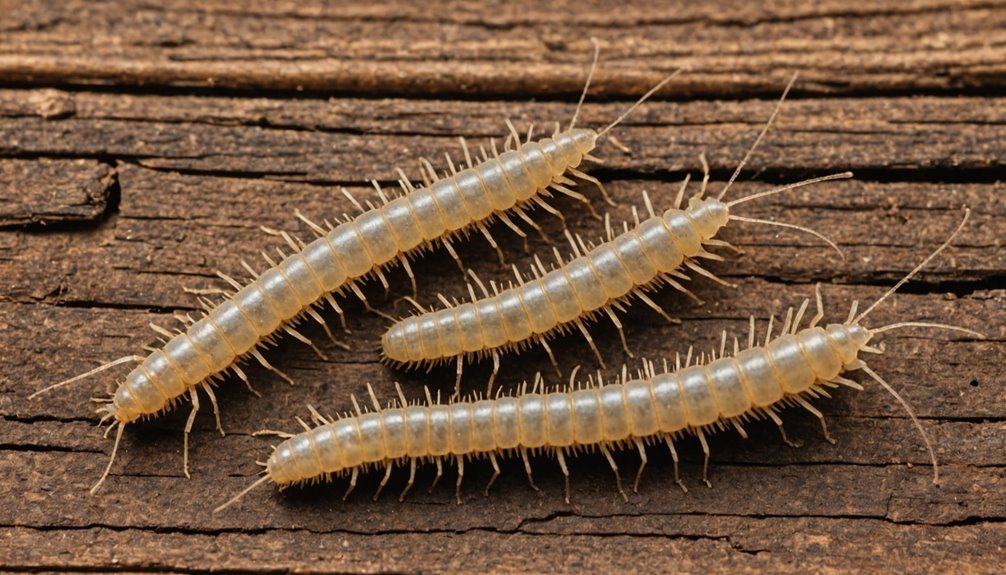
Telling termite larvae apart from ant larvae can be tricky, since both are pale, soft-bodied, and small enough to blur together at a glance.
Look beyond color and focus on these sharper clues:
Color alone won’t cut it — sharpen your eye and look for the details that actually tell the story.
- Body shape: Termite larvae look like tiny worker termites — uniform and rectangular. Ant larvae appear more elongated and grub-like.
- Waist: If you spot adults nearby, a pinched waist means ants. A broad, seamless body means termites.
- Wood damage: Ragged tunnels and mud tubes point to termites. Smooth galleries with sawdust outside signal carpenter ants.
- Colony visibility: Ant workers carry larvae openly. Termite larvae stay hidden deep inside galleries — finding them means the infestation’s already serious.
- Antennae: Once larvae mature into adults, termites develop straight, bead-like antennae, while ants have distinctly elbowed antennae that curve at a sharp angle.
How to Tell Termite Larvae Apart From Maggots
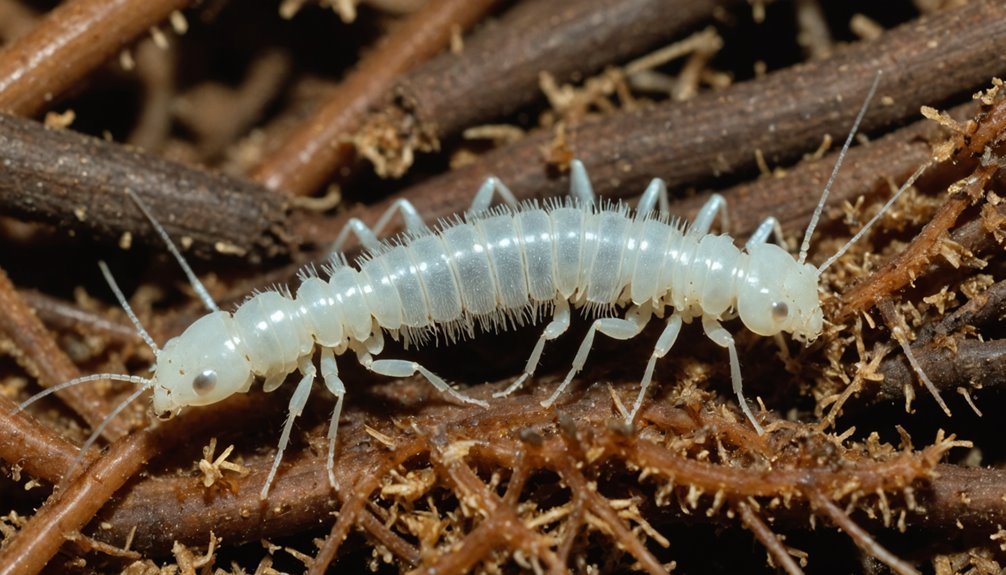
When you spot a pale, worm-like insect near suspected termite activity, the fastest check is looking for legs.
Termite larvae carry six legs and a distinct head capsule, while maggots have neither. That single physical difference lets you rule out fly larvae almost immediately, even before checking antennae or location.
Spotting Physical Differences
One of the quickest ways to tell termite larvae apart from maggots is by looking at their body shapes. Termite larvae look like miniature versions of adult termites, while maggots appear tube-shaped and worm-like.
Here’s what to watch for:
- Head distinction – Termite larvae have a clearly defined head; maggots blend right into the body.
- Antennae – You’ll spot straight antennae on termite larvae, something maggots completely lack.
- Segmentation – Termite larvae show visible, organized segments; maggots look smooth and featureless.
- Size variety – Seeing multiple sizes clustered together signals a termite colony, not a maggot infestation.
Don’t rely on color alone since both insects share pale, white tones that can easily mislead you.
Legs Versus No Legs
The clearest physical difference between termite larvae and maggots is simple: termite larvae have six legs, and maggots have none. If you spot legs on the small, pale insects you’ve found, you’re most likely dealing with termite larvae rather than maggots.
Beyond the legs, termite larvae have a distinct head and a clearly segmented body. Maggots, by contrast, have a smooth, legless form with barely visible head structures. These differences are visible without magnification if you look closely.
Watch how they move, too. Termite larvae walk with purposeful movement, while maggots wriggle and contract.
If the insects you’re observing are walking rather than writhing, their legged bodies and movement together strongly point toward termite larvae.
Where Are Termite Larvae Found Inside a Colony?
Knowing where termite larvae reside inside a colony can help you understand how an infestation develops and why they’re so rarely spotted.
Larvae stay buried deep within the nest’s core, far from foraging tunnels or damaged wood you’d notice first.
Termite larvae hide deep in the nest’s core, nowhere near the damage or tunnels you’d find first.
Here’s where they’re concentrated:
- Central nest interior — the colony’s most guarded, hidden zone
- Brood chambers — nursery-like areas managed entirely by worker termites
- Moist, soil-connected voids — crawlspaces, foundation gaps, and mud-tube networks
- Near active workers — larvae never survive alone; workers feed and protect them constantly
If you’re finding larvae, the colony isn’t new.
It’s established, organized, and likely expanding somewhere you haven’t discovered yet.
Why Termite Larvae Are Almost Impossible to Spot
Even if termite larvae were crawling right in front of you, you’d likely miss them. At less than 1/10 inch long, their pale, near-translucent bodies blend into dark wood and soil without contrast. They look like tinier versions of worker termites, not distinct grubs, so you wouldn’t recognize them without magnification.
Beyond their appearance, their location works against you. Workers keep larvae buried deep inside protected nursery zones, far from the exposed surfaces you’d actually inspect. You’d need to break into concealed wood galleries or soil nests to reach them.
Because workers feed larvae directly through trophallaxis, larvae rarely move independently. Your first sign of an infestation is almost always swarmers, mud tubes, or damaged wood, never larvae themselves.
Signs You Have Termite Larvae in Your Home
Since termite larvae stay hidden deep inside wood or soil, you won’t spot them directly—but the colony’s activity leaves clear evidence behind.
Look for pencil-sized mud tubes running along your foundation, crawl space walls, or baseboards, and tap nearby wood to check for the hollow sound that signals internal feeding damage.
You should also check windowsills, door frames, and light sources for discarded wings, since swarmers shedding wings indoors almost always means an active colony is already established nearby.
Mud Tubes and Wood Damage
While termite larvae stay hidden deep inside a colony, the signs they leave behind are often visible if you know where to look. Check your foundation lines, crawl spaces, and walls for pencil-thin mud tubes — termites build these as protected travel tunnels.
Break a small section; if it’s repaired within days, you’ve got an active infestation.
Wood damage tells an equally alarming story:
- Hollow-sounding wood means termites have eaten through it from the inside out.
- Soft, crumbly, or brittle timber signals serious structural compromise.
- Blistered or bubbling paint often hides damage underneath.
- Sagging floors, stuck doors, or warped frames mean the damage has already spread dangerously far.
Don’t wait — get a professional inspection immediately.
Discarded Wings Near Entryways
If you spot small, translucent wings scattered near your windowsills, door frames, or entryways, take it seriously — it’s one of the clearest warnings that termites have already moved in.
These wings belong to swarmers that emerged from a nearby mature colony, and finding them indoors suggests the colony may be inside or directly adjacent to your home.
Don’t confuse them with ant wings — termite wings are roughly equal in size, while ant swarmers have longer front wings and a pinched waist.
Don’t disturb the area. Instead, collect a few wings in a container, note the exact location, and contact a pest professional immediately.
Indoor wings aren’t something to wait on — they signal active colony activity that requires prompt inspection.
Mud Tubes, Frass, Hollow Wood, and Discarded Wings Explained
When looking for signs of termite activity, four clues stand out above the rest: mud tubes, frass, hollow wood, and discarded wings. Each one tells a different story about what’s happening inside your home.
- Mud tubes mean subterranean termites are actively traveling through your walls or foundation.
- Frass signals drywood termites are feeding and leaving waste behind inside your wood.
- Hollow wood reveals internal galleries where termites have already destroyed structural integrity.
- Discarded wings confirm a mature colony has swarmed, meaning the infestation isn’t new.
Don’t wait until damage becomes visible. If you spot even one of these warning signs, treat it as urgent.
Early detection protects your home before termites cause irreversible structural harm.
What to Do When You Find Termite Larvae in Your Home
Finding termite larvae in your home demands an immediate but measured response. Leave the area undisturbed so hidden termites don’t scatter deeper into walls or wood galleries. Avoid DIY spot treatments as your only step—visible larvae almost always indicate a larger infestation requiring professional evaluation.
| Step | Action |
|---|---|
| Confirm | Probe and tap wood for hollow spots |
| Inspect | Check foundations, crawl spaces, and wall voids |
| Contact | Hire a licensed pest control company |
| Treat | Expect liquid, bait, foam, or fumigation options |
Request a professional inspection quickly. A licensed company will assess the infestation type and recommend appropriate treatment. Don’t begin major repairs beforehand, since professional evaluation determines whether damaged wood needs replacement or treatment first.
Frequently Asked Questions
How Long Does It Take for Termite Larvae to Become Adults?
You’re looking at roughly one year for termite larvae to become adults. Development speed varies by species, temperature, moisture, and food availability, with nymphs molting multiple times before reaching their final worker, soldier, or reproductive caste.
Can Termite Larvae Survive if Separated From the Colony?
Termite larvae can’t survive if they’re separated from the colony. They depend entirely on workers for food and care. Without worker support, you’ll find that isolated larvae quickly starve and die.
Do Termite Larvae Cause Any Direct Damage to Wood Structures?
Termite larvae don’t directly damage wood structures. They can’t digest wood on their own, so you won’t find them tunneling or hollowing beams. Your real concern is the worker termites supporting the colony’s growth.
How Many Larvae Can a Termite Queen Produce Daily?
You’re looking at a wide range here — a termite queen can produce hundreds to tens of thousands of larvae daily, with some species hitting around 30,000, depending on colony maturity and species type.
Are Termite Larvae Harmful to Humans or Household Pets?
Termite larvae aren’t harmful to you or your pets. They don’t bite, transmit diseases, or poison animals. However, they can trigger allergies or worsen respiratory issues, and they’ll cause serious structural damage to your home.
Conclusion
Finding termite larvae in your home means you’ve got an active colony that’s already causing damage. Don’t wait to act—contact a licensed pest control professional immediately. The earlier you catch an infestation, the less structural damage you’ll face. Remember, you can’t effectively eliminate termite larvae through DIY methods alone. A professional inspection gives you the best chance of protecting your home before the problem grows beyond control.