

Essential Oils for Termites: 6-Hour Kills, 24-Day Protection
Several essential oils can repel or kill termites naturally, offering a natural, lower-toxicity alternative to synthetic insecticides for homeowners who want a first line of defense. Vetiver oil offers the longest-lasting protection, disrupting tunneling for up to 24 days. Clove oil kills termites fastest, achieving 100% mortality within six hours. Cinnamon, mint, orange, and cedarwood oils each bring unique advantages, from contact killing to perimeter defense. You’ll want to match the right oil to your specific situation, and there’s quite a bit more to unpack about making these work effectively.
Do Essential Oils Actually Repel Termites?

The short answer is yes some essential oils genuinely repel termites, not just kill them. Researchers have measured this repellency directly, tracking how strongly termites avoid treated areas over time. Some oils achieve over 80% avoidance within hours, which is a measurable, documented effect not anecdotal.
That said, repellency isn’t universal across all oils. The effect depends on the species of termite, the concentration you’re using, and how much time has passed since application.
Some oils also do double duty, combining repellency with direct toxicity.
What you’re working with here isn’t a guaranteed barrier system. Think of essential oils as short-range deterrents backed by real lab data strongest under controlled conditions, but still meaningful when you understand their limitations. They won’t stop an active infestation from spreading through your home’s structure on their own, which is why they work best paired with inspection and, where needed, professional treatment. The termite species studied in this context is Microcerotermes crassus, a target used in controlled in vitro experiments to evaluate the termiticidal activity of medicinal plant essential oils.
Vetiver Oil: The Most Long-Lasting Termite Repellent
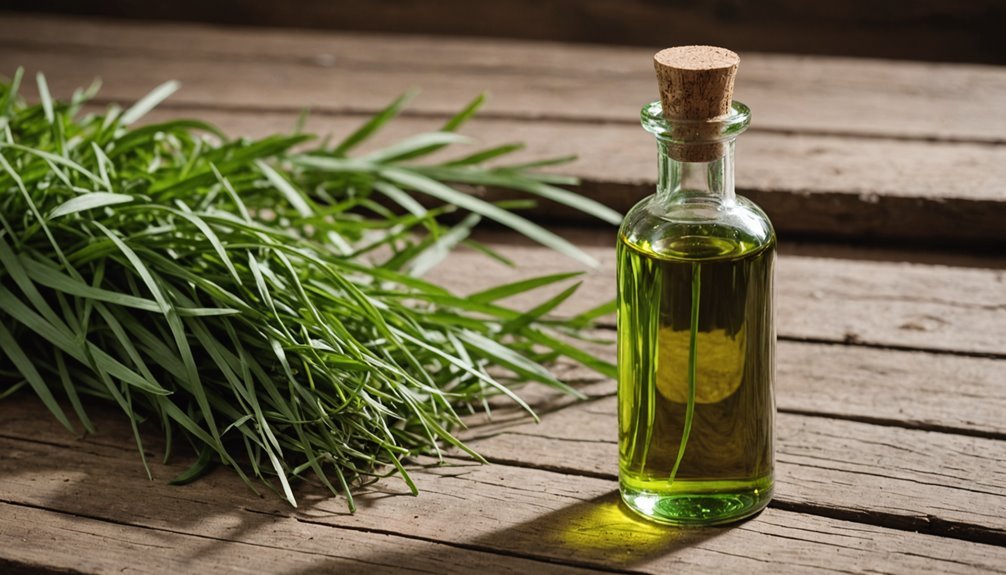
When researchers tested eight insect-active essential oils against the Formosan subterranean termite, vetiver oil came out on top because of its long-lasting repellency, which can stretch from 12 to 24 days.
You’ll find that it disrupts termite tunneling at concentrations as low as 5 µg/g sand, and at 25 µg/g sand, termites stop tunneling and feeding altogether.
That kind of targeted, low-dose effectiveness makes vetiver oil a promising eco-friendly alternative to conventional termiticides and synthetic insecticides. Among the eight oils tested, clove bud oil was identified as the most toxic, killing 100% of termites within 2 days at a concentration of 50 µg/cm².
Why Vetiver Lasts
Among the eight insect-active essential oils tested against the Formosan subterranean termite (Coptotermes formosanus), vetiver oil stood out as the most effective repellent not because it kills fastest, but because it lasts longest.
Its persistence comes from a mixture of bioactive compounds, not a single fast-evaporating molecule.
| Compound | Role | Effect |
|---|---|---|
| Nootkatone | Primary bioactive | Repellency + toxicity |
| Zizanol | Secondary constituent | Termite deterrence |
| Bicyclovetivenol | Aromatic molecule | Sustained barrier activity |
These compounds work together, remaining active in treated substrates rather than dissipating quickly. Vetiver oil also alters the soil’s chemical profile, reducing termite-resistant landscaping. That combination of bioactivity and substrate persistence not fumigation-style knockdown explains why vetiver oil’s repelling duration reaches 12–24 days.
Both plants that repel termites have been evaluated as soil barrier treatments, with research confirming that nootkatone reduces termite activity by as much as 80% at a concentration of 2%.
Key Repellency Concentrations
These numbers come from a sand-based assay, so don’t apply them directly to other formats without caution unit differences across studies make cross-comparison tricky.
What the data tells you clearly, though, is that vetiver oil disrupts termite behavior across a concentration range, starting at very low loads and reaching full suppression at moderate ones.
That dose-response pattern is what makes it practically useful. Vetiver essential oil contains over 200 compounds, primarily sesquiterpenoids and hydrocarbons, which likely contributes to its broad behavioral disruption across concentration levels.
Eco-Friendly Termite Control
Vetiver oil stood out as the most effective repellent among eight insect-active essential oils tested against the Formosan subterranean termite, and its edge over the competition came down to one key trait: durability. Its repellency lasted 12–24 days, making it far more useful than short-lived contact repellents.
That persistence is exactly why researchers consider vetiver oil a serious eco-friendly termite-control and prevention candidate. You’re not just deterring termites temporarily, you’re disrupting their tunneling behavior, reducing wood consumption, and affecting their symbiotic gut fauna over time.
Vetiver root mulch adds another layer, contributing to suppression through landscape materials alone.
While clove bud kills faster and nootkatone deters more strongly in short-term tests, vetiver oil’s combination of lasting repellency and behavioral disruption makes it uniquely practical for ground-contact and urban landscape protection. In a 21-day study, vetiver oil and nootkatone applied at 100 μg/g substrate significantly reduced termite survival rates when termites were required to tunnel through treated sand to reach food.
Clove Oil: The Fastest Termite Killer in the Group

If you’re looking for the fastest-acting essential oil against termites, clove oil stands out by reaching 100% termite mortality within just 6 hours at 250 µL/L.
Its high eugenol content attacks termite nervous systems directly, making it both a potent contact killer and a strong repellent.
You’ll get the best results applying it as a direct-contact spray, since its acute toxicity and rapid knockdown make it far better suited to that method than to slow-release baiting systems.
Rapid Termite Kill Rate
Among the essential oils studied for termite control, clove oil kills the fastest. In a comparative in vitro study, it reached 100% termite mortality within just 6 hours at 250 µL/L. Its LT50 was 2.08 hours, meaning it took only about 2 hours to kill half the test population.
That’s significantly faster than cinnamon, star anise, and the other oils in the same study.
You’ll also see this speed reflected across different exposure formats. At 50 µg/cm², clove bud oil wiped out 100% of Formosan termites in 2 days. At 0.5 µL/L of air, it achieved 100% mortality in Japanese termites.
Higher concentrations consistently produce faster results, so if speed of kill is your priority, clove oil delivers it most reliably.
Eugenol’s Toxic Mechanism
Clove oil’s speed comes down to one compound: eugenol. As a lipophilic phenolic, it penetrates insect cuticle rapidly and attacks on multiple fronts simultaneously.
It disrupts cell membranes by increasing permeability, causing leakage and cellular breakdown. It interferes with octopamine receptors, destabilizing the termite’s nervous system and triggering paralysis.
It also inhibits carboxylesterase and glutathione S-transferase, the enzymes termites rely on to neutralize toxins. Once those fail, the termite can’t detoxify anything, and chemical stress accumulates until death follows.
This isn’t a slow-acting growth inhibitor. It’s a contact toxicant hitting membranes, nerves, and detoxification pathways at once. That multi-site pressure explains why isolated eugenol carries an LC50 of just 12.1 μg/g and kills all exposed termites within three days.
Best Application Methods
Putting clove oil to work against termites comes down to two things: concentration and placement. For direct contact, mix several drops into a quart of water and spray infested wood, foundation cracks, and woodpiles. At 50 µg/cm², you’ll see 100% termite mortality within two days.
| Target Area | Application Method |
|---|---|
| Foundation cracks | Diluted spray directly into gaps |
| Infested furniture/doors | Light spray on affected surfaces |
| Outdoor woodpiles | Repeated spray on high-contact zones |
Don’t skip reapplication, clove oil’s residual effect is short-lived. Since it’s highly concentrated, always dilute it first to avoid skin irritation. Focus your treatments where you’ve spotted termite activity, not just on visible insects.
Cinnamon Oil: Why Cinnamaldehyde Does the Heavy Lifting
When people talk about cinnamon oil as a termite deterrent, they’re really talking about cinnamaldehyde. This compound drives most of the oil’s termiticidal punch, outperforming other cinnamon components in direct-contact testing against *Coptotermes formosanus*.
It doesn’t just kill, it also deters feeding and repels termites, making it useful as a barrier treatment.
That said, not all cinnamon oils are the same. Some are cinnamaldehyde-rich; others are eugenol-dominant. In testing against *Microcerotermes crassus*, eugenol matched the parent oil’s performance closely.
So the source, plant part, and chemotype all affect what you’re actually getting.
If you want reliable results, look for oils with a high cinnamaldehyde content. That’s where the strongest, most consistent termite-suppressing activity comes from.
Mint Oil and Orange Oil for Fast-Contact Termite Kill
Cinnamon oil earns its reputation through chemistry, but it’s not the only botanical that can stop termites fast.
Mint oil, particularly peppermint, can kill 100% of termite workers within 30 minutes at a 10% concentration. Even at 0.12%, it still achieves complete mortality just over 10 hours instead of minutes. Its active compounds, especially menthol, work by inhibiting acetylcholinesterase, disrupting the termite nervous system directly.
At higher doses, mint oil also repels, so its behavior shifts with concentration.
Orange oil relies on d-limonene for contact toxicity and works fast when termites encounter it directly. The catch is its short residual life. It won’t penetrate deep into a colony, so you’ll get localized kills, not structural eradication.
Lavender Oil for Protecting Wood From Termite Damage
Lavender oil takes a different approach instead of killing termites on contact, it works as a wood preservative. Research shows that dipping spruce wood in a 5% lavender oil solution produces termite resistance nearly matching commercial biocide treatments.
That’s a meaningful result from a simple, low-tech application method. The protection likely comes from linalool, lavender’s dominant aromatic compound, which disrupts termite communication trails and deters feeding.
Some sources also describe contact toxicity, though that evidence is less rigorous. You should treat lavender oil as a preventive treatment rather than a cure.
The strongest data applies specifically to spruce wood against *Reticulitermes flavipes*, so don’t assume equal performance across all wood types or termite species.
Cedarwood, Neem, and Tea Tree as Perimeter Repellents
Three essential oils show up consistently in perimeter-focused termite deterrence: cedarwood, neem, and tea tree. Each works differently, but all three target entry points rather than active infestations.
- Cedarwood has documented repellency and toxicity against *Coptotermes formosanus*, with heartwood-derived variants showing 100% mortality at tested doses.
- Neem disrupts termite feeding, growth, and reproduction, making it better suited for long-term pressure than rapid knockdown.
- Tea tree relies on potent terpenes to make wooden surfaces unattractive to termites.
Citronella oil turns up in a lot of DIY termite blends too, largely riding on its reputation as a mosquito and general insect repellent. The termite-specific research behind it is thinner than what backs vetiver, clove, or cedarwood, so it’s best treated as a secondary addition to a blend rather than your primary line of defense.
Apply diluted blends to door frames, window sills, cracks, and gaps, and reapply consistently since volatile oils lose effectiveness quickly.
None of these replace professional treatment, but they’re practical additions to a perimeter defense routine.
How to Mix a DIY Termite Repellent Spray
Once you’ve identified your perimeter entry points, mixing a spray to treat them is straightforward. Fill a 4 oz glass bottle with 2 oz distilled water and 1 oz witch hazel, then add your essential oils last.
| Essential Oil | Drops per 4 oz Bottle |
|---|---|
| Orange or Clove | 10–15 drops |
| Peppermint or Lemongrass | 10–15 drops |
Combine one or both oils to reach 15–20 total drops for your finished blend. Shake thoroughly before each use since oil and water always separate. Target visible termite areas and entry-related surfaces directly. Reapply periodically because light DIY blends lose potency after cleaning or rain exposure. Store your labeled bottle away from heat and sunlight to slow degradation, and jot down the dilution ratio you used so a blend that works is easy to repeat.
Where to Apply Essential Oils to Stop Termites
Knowing where to apply essential oils matters as much as which oils you use. Focus on high-impact zones rather than spraying randomly across your home.
Target these key areas:
- Entry points – Treat cracks in walls, door frames, window frames, and foundation gaps where termites enter.
- Infested wood – Spray directly onto damaged floorboards, furniture, or timber showing tunneling or bite marks.
- Active hotspots – Apply around mud tubes, hollow wall spaces, and basement zones with visible termite activity.
- Indoor concealment zones – Place soaked cotton balls in drawers, cupboards, and behind furniture where termites hide.
Since essential oils evaporate quickly, you’ll need to reapply regularly to maintain any repellent effect across treated zones.
How Often to Reapply for Lasting Protection
How often you reapply matters as much as where you apply. For most indoor areas, refreshing every three to seven days keeps the scent barrier effective.
In termite-prone zones, treat at least once a week as your minimum. If you’re dealing with heat, rain, wind, or direct sunlight, tighten that schedule, those conditions accelerate evaporation and break down the odor faster.
Cotton-ball applications tend to last longer than sprays, but you’ll still need to replace them once the scent fades. That fading smell is your clearest signal it’s time to reapply.
If termite activity returns, the barrier’s already weakened. To prevent resistance, rotate your oils periodically. Consistent inspection tells you whether your current interval is actually working or needs adjusting. Essential oils work best as one layer of a broader prevention plan, for the rest of that plan see our termite prevention checklist for homeowners.
Frequently Asked Questions
Can Essential Oils Replace Professional Termite Treatment for Severe Infestations?
You can’t replace professional termite treatment with essential oils for severe infestations. They’re best used as supplemental repellents or preventive barriers, not colony eliminators, since they don’t reach hidden galleries or destroy entire nest structures.
Can You Combine Essential Oils With Other Termite Treatments?
Yes. Essential oils work well layered alongside conventional treatments rather than instead of them, for example as a supplementary barrier around entry points while a professional handles bait stations, a liquid termiticide, or another labeled insecticide for the active colony. Combining methods this way is standard practice in integrated pest management and doesn’t reduce the effectiveness of either approach, but always check with your pest control professional before mixing products near a treated area.
Are Essential Oils Safe to Use Around Pets and Small Children?
Some essential oils aren’t safe around pets and small children. You’ll need to dilute them properly, ensure ventilation, and avoid oils like tea tree or eucalyptus. Always consult your vet or pediatrician first.
Do Essential Oils Work Against All Termite Species, Not Just Subterranean?
You can’t count on essential oils to work against all termite species. Most studies only test subterranean termites, so the evidence doesn’t extend to every species you might encounter.
Can Essential Oils Damage Wood Surfaces or Finishes When Applied Directly?
Yes, undiluted essential oils can damage wood surfaces. You’ll risk discoloration, softening, or finish stripping if you apply them directly. Always dilute properly, use 5–10 drops per gallon of water to stay safe.
Where Can You Buy High-Quality Essential Oils Suitable for Termite Control?
You can buy high-quality essential oils for termite control from specialty retailers, health-food stores, or verified online marketplaces. Look for products listing botanical names, GC/MS batch testing, organic certification where available, and 100% pure, single-ingredient oils.
Conclusion
You’ve now got a solid list of natural essential oil alternatives that can help you fight back against termites. From vetiver’s long-lasting protection to clove oil’s quick-kill power, you’re not short on options. Mix your blend, apply it consistently, and reapply every few weeks to keep your barriers strong. These oils won’t replace professional treatment for severe infestations, but they’ll give you a meaningful first line of defense.

Pingback: Does Bleach Kill Termites? What Actually Works