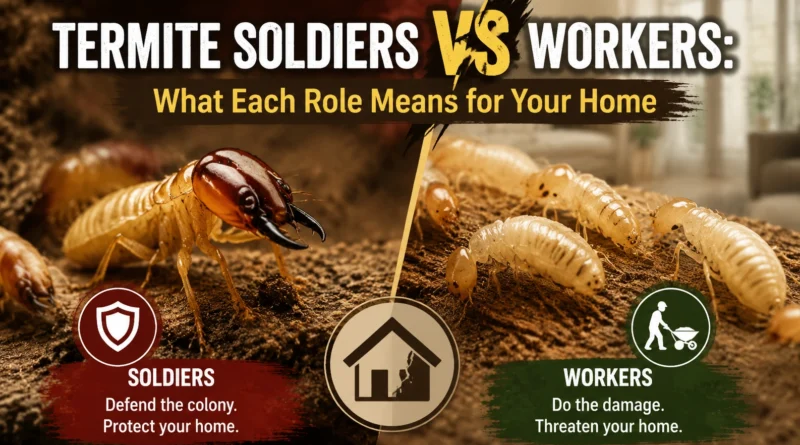
Termite Soldiers vs Workers: What Each Role Means for Your Home
Most homeowners picture termites as one uniform swarm of destructive insects. The reality is far more organized and far more alarming. A termite colony operates like a structured society with specialized roles, and the two castes you are most likely to encounter inside your home are termite soldiers and termite workers. Understanding what each one does, what they look like, and what finding them means for your property could save you from catastrophic structural damage.
The Termite Caste System Explained
Every termite colony is built around a rigid division of labor. There is a reproductive pair at the top, a queen and a king, whose only job is to produce offspring. Below them are three main castes: workers, soldiers, and reproductives known as swarmers. Each caste has a distinct physical appearance and a clearly defined function. The colony’s survival depends entirely on every member fulfilling its role without deviation.
This level of organization is part of what makes termites so dangerous. They do not wander randomly. They operate with purpose, and that purpose, in the case of workers, is the relentless consumption of the cellulose found in the wood of your home. To understand the full picture of how colonies grow and behave, our termite lifecycle guide covers every stage in detail.
Termite Workers: The Caste Actually Destroying Your Home
Termite workers make up the largest portion of any colony, often representing 80 to 90 percent of the total population. They are the ones doing the damage. Workers are responsible for foraging, feeding, tunneling, and caring for the eggs and young. Every piece of structural wood, flooring, and framing that termites consume is consumed by workers.
What Termite Workers Look Like
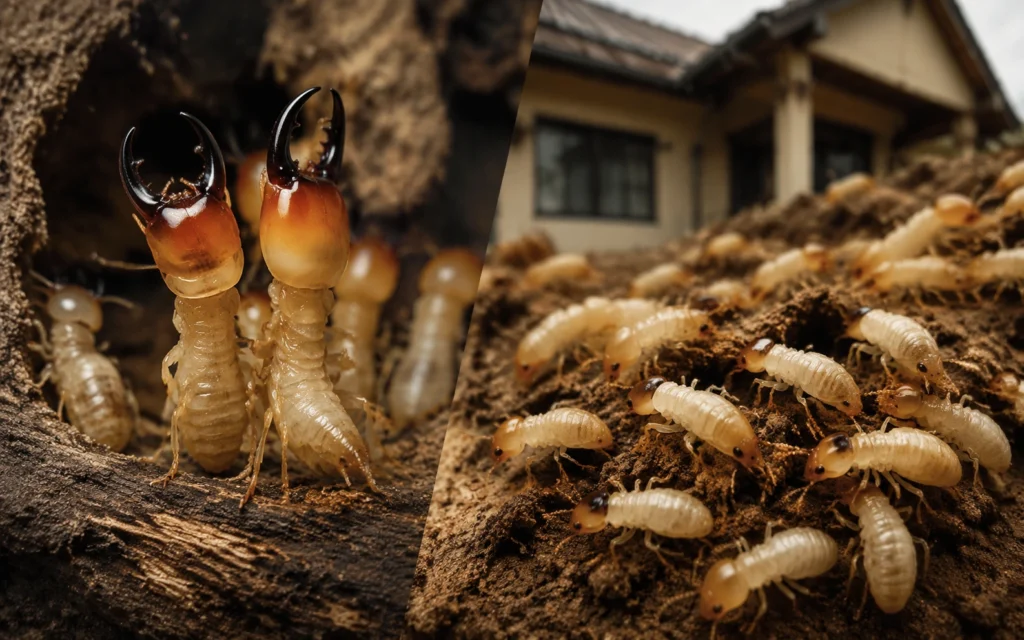
Workers are the smallest members of the colony. They are creamy white to pale yellow in color, soft-bodied, and completely blind. They range from about 3 to 4 millimeters in length. Because they spend their entire lives inside tunnels and galleries within wood or soil, they have no need for eyes or pigmentation. Their soft appearance is deceptive. A single mature subterranean termite colony containing hundreds of thousands of workers can consume roughly a pound of wood per day.
If you discover small, pale, soft-bodied insects inside a piece of damaged wood or beneath flooring, you are almost certainly looking at termite workers. This is an urgent finding. Workers inside visible wood mean the infestation has already progressed to the point of structural compromise.
Termite Soldiers: The Colony’s Defense Force
Termite soldiers exist for one purpose: to defend the colony against threats, primarily ants and other insects that attempt to invade. Soldiers cannot feed themselves. They are entirely dependent on workers to provide them with food. In exchange, they guard the tunnel entrances and attack any intruders with their powerful mandibles or, in some species, by secreting a defensive chemical substance from a specialized gland on their head.
What Termite Soldiers Look Like
Termite soldiers are immediately distinguishable from workers by their oversized, heavily armored heads. Their heads are typically dark orange, amber, or brown, while their bodies remain the same pale color as workers. Soldiers are slightly larger than workers and their mandibles are disproportionately large relative to their body size. In some species, particularly subterranean termites, soldiers also have a rectangular head that appears almost elongated.
The presence of soldiers near damaged wood or along tunnel walls is a definitive sign of active colony activity. Where you find soldiers, workers are always nearby and feeding. Knowing the visual differences between termite species is essential, and our detailed termite identification guide breaks down the key markers for each type.
Key Differences Between Soldiers and Workers at a Glance
| Feature | Termite Workers | Termite Soldiers |
|---|---|---|
| Head Color | Pale white or cream | Dark orange or brown |
| Head Size | Proportional to body | Oversized and hardened |
| Mandibles | Small, used for feeding | Large, used for defense |
| Primary Role | Feeding and tunneling | Colony defense |
| Colony Percentage | 80 to 90 percent | 1 to 3 percent |
| Can Feed Itself | Yes | No |
What Finding Either Caste in Your Home Means
Spotting either termite workers or termite soldiers inside your home is never a minor issue. Both castes indicate the same thing: an active, established colony is living within or directly adjacent to your structure.
Workers found inside damaged wood confirm that feeding has been ongoing, potentially for months or years. The damage you see is rarely the full extent of the destruction. Termites feed from the inside out, meaning the surface often appears intact while the interior is completely hollow. According to the U.S. Environmental Protection Agency, termites cause more than five billion dollars in property damage annually in the United States, most of which is not covered by standard homeowners insurance.
Soldiers near exposed wood or tunnel openings signal that the colony is large enough to require active defense. A colony does not produce significant numbers of soldiers until it has reached a mature size, which in subterranean species can mean hundreds of thousands of individuals. This is the difference between subterranean and drywood termites that matters most when assessing threat level and treatment approach.
Other Warning Signs to Look for at the Same Time
When you discover workers or soldiers, inspect the surrounding areas immediately for additional evidence. Look for mud tubes along your foundation, hollow sounds when tapping walls, buckling floors, bubbling paint, and frass deposits near wooden surfaces. A full checklist of what to watch for is available in our guide on signs of termites in walls, floors, and ceilings. The more evidence you collect before your professional inspection, the more accurately the technician can map the colony’s spread.
What to Do Immediately After Finding Termite Castes
Do not disturb the area beyond what is necessary to collect a sample. Termite colonies will relocate feeding activity if they detect a disturbance, making them harder to locate and treat. Place a few specimens in a sealed bag or photograph them clearly for identification. Contact a licensed pest control professional the same day.
Once the infestation is confirmed, your technician will assess the scope of the colony and recommend the appropriate treatment. Our complete termite treatment options guide covers everything from liquid barrier applications and bait station systems to localized foam treatments, so you can approach the conversation with your pest control provider fully informed.
Conclusion
Termite workers are the ones destroying your home. Termite soldiers are the ones protecting the colony that is destroying your home. Finding either one is a clear signal that professional intervention is needed without delay. The longer a colony is active, the more structural damage accumulates and the more expensive treatment and repairs become. Identify the caste, document the evidence, and act immediately.
{
“@context”: “https://schema.org”,
“@type”: “Article”,
“headline”: “Termite Soldiers vs Workers: What Each Role Means for Your Home”,
“description”: “Learn the roles of termite soldiers vs workers and what spotting either caste inside your home means for your property.”,
“author”: {
“@type”: “Organization”,
“name”: “Termite Control Care”
},
“publisher”: {
“@type”: “Organization”,
“name”: “Termite Control Care”,
“url”: “https://termitecontrolcare.com”
},
“mainEntityOfPage”: {
“@type”: “WebPage”,
“@id”: “https://termitecontrolcare.com/termite-soldiers-vs-workers-roles-home/”
}
}
{
“@context”: “https://schema.org”,
“@type”: “FAQPage”,
“mainEntity”: [
{
“@type”: “Question”,
“name”: “What do termite workers look like?”,
“acceptedAnswer”: {
“@type”: “Answer”,
“text”: “Termite workers are small, creamy white to pale yellow, soft-bodied, and blind. They measure about 3 to 4 millimeters in length and have proportional heads with small mandibles designed for feeding on wood and cellulose materials.”
}
},
{
“@type”: “Question”,
“name”: “What do termite soldiers look like?”,
“acceptedAnswer”: {
“@type”: “Answer”,
“text”: “Termite soldiers have large, dark orange or brown heads that are disproportionately big compared to their pale bodies. Their oversized mandibles are used for defense rather than feeding. Soldiers make up only 1 to 3 percent of a colony and cannot feed themselves.”
}
},
{
“@type”: “Question”,
“name”: “Which termite caste causes structural damage?”,
“acceptedAnswer”: {
“@type”: “Answer”,
“text”: “Termite workers cause all the structural damage. They are responsible for foraging, tunneling, and consuming the wood in your home. Soldiers defend the colony but do not feed on wood. Finding workers inside damaged wood confirms an active, feeding infestation.”
}
},
{
“@type”: “Question”,
“name”: “What does finding termite soldiers in your home mean?”,
“acceptedAnswer”: {
“@type”: “Answer”,
“text”: “Finding termite soldiers means a mature, active colony is present within or very close to your home. Colonies only produce significant numbers of soldiers once they reach a large, established size. It is a sign that professional inspection and treatment is urgently needed.”
}
},
{
“@type”: “Question”,
“name”: “How are termite workers different from termite soldiers?”,
“acceptedAnswer”: {
“@type”: “Answer”,
“text”: “Workers are pale, small, and uniform in appearance with proportional heads. Soldiers have enlarged, darkened heads and oversized mandibles. Workers feed on wood and make up 80 to 90 percent of the colony. Soldiers defend the colony and depend entirely on workers for food.”
}
}
]
}