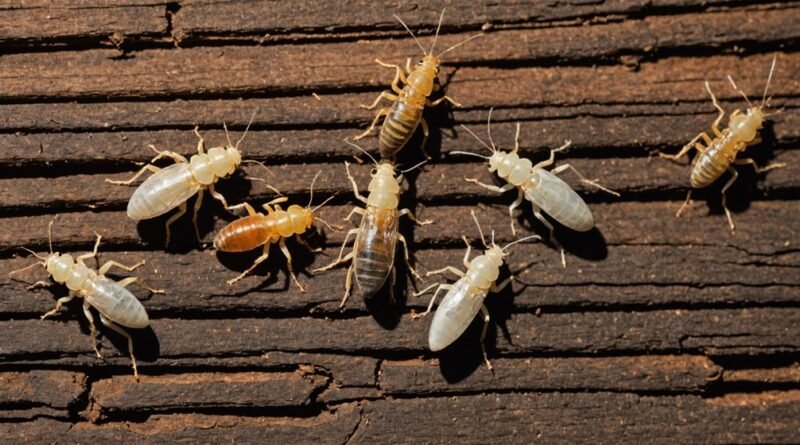
White Termites Vs Regular Termites
When you spot white termites, you haven’t found a separate species — you’re looking at worker termites from a standard colony. They’re creamy white, soft-bodied, and about 1/8 inch long, with straight, beaded antennae. Every termite species produces these pale workers, whether subterranean, drywood, or Formosan. Their white color simply means they never leave the dark tunnels they destroy from the inside. Keep going to understand exactly what they’re doing to your home.
Key Takeaways
- “White termites” are not a separate species; they are the worker caste found within any standard termite colony.
- Workers appear creamy white due to living inside wood, never exposed to light, while other castes darken over time.
- Subterranean, drywood, and Formosan termites all produce pale white workers, making color unreliable for species identification.
- All termite species share the same physical traits: straight beaded antennae, thick waist, and soft bodies.
- The term “white termites” simply describes caste appearance, not a biologically distinct or more dangerous termite type.
What Do White Termites Actually Look Like?
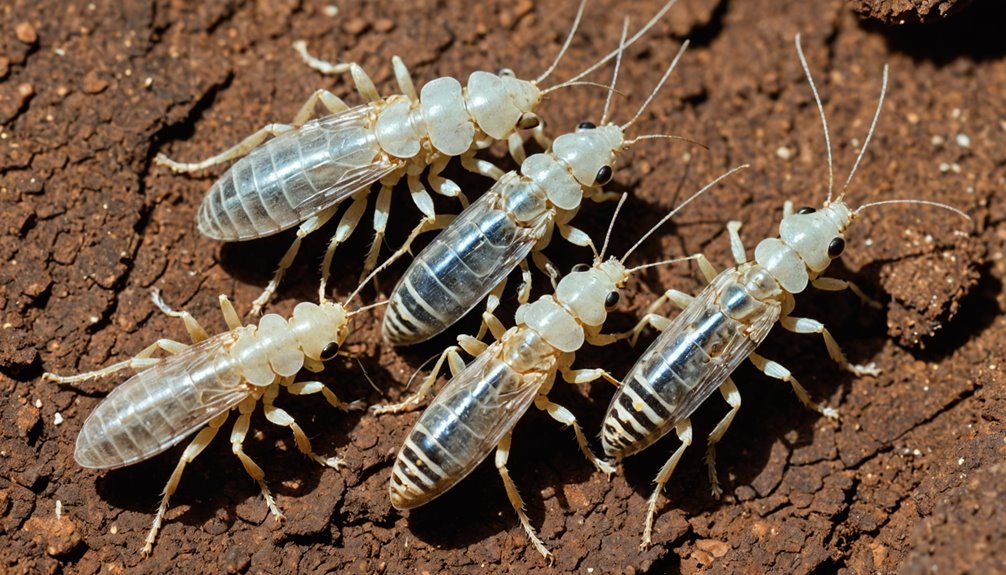
White termites aren’t actually a separate species — they’re simply the worker caste of a standard termite colony, and they’re the ones you’re most likely to stumble across when you crack open a mud tube or split apart infested wood.
Workers are creamy white to pale tan, with soft bodies and a broad, uniform shape from thorax to abdomen — no pinched waist like you’d see on an ant. They’re tiny, usually around 1/8 inch, and their straight, beaded antennae help set them apart.
Soldiers share that pale body but carry darker heads and larger jaws. Swarmers, by contrast, are brown to black.
Termites also have two pairs of equal-length wings, which they shed once they’ve found a suitable location to establish a new colony.
White Termites vs Ants: How to Tell Them Apart
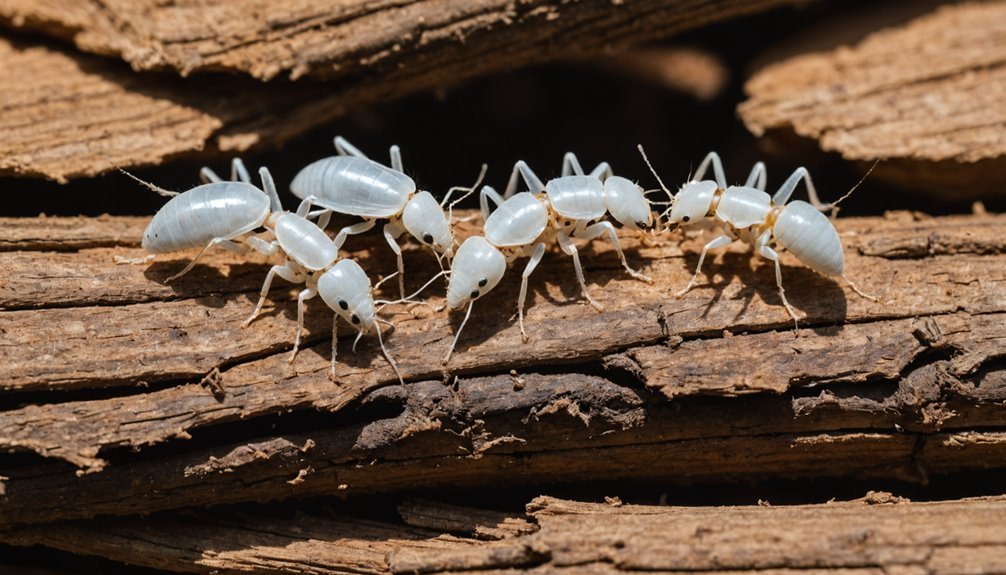
One of the most common misidentifications in pest control is mistaking pale worker termites for ants — and it’s an easy mistake to make when you’re moving fast. Knowing what to check keeps you from treating the wrong pest entirely. Termites are actually a different species from ants, despite the widespread confusion caused by their similar pale coloring.
| Feature | Termites |
|---|---|
| Waist | Straight, thick body |
| Antennae | Straight, beaded |
| Wings (swarmers) | Equal-sized pairs |
| Wood behavior | Consume wood |
| Galleries | Rough, dirt-lined |
| Feature | Ants |
| Waist | Clearly pinched |
| Antennae | Bent, elbowed |
| Wings (swarmers) | Unequal-sized pairs |
| Wood behavior | Excavate only |
| Galleries | Smooth, finished |
Focus first on the waist and antennae — those two checks alone eliminate most confusion before you investigate further.
Are White Termites a Different Species From Regular Termites?

When you spot pale termites crawling through damaged wood, it’s tempting to assume they’re a different species from the darker ones you’ve seen elsewhere — but that assumption isn’t accurate.
“White termites” isn’t a species name; it’s a description of color, most often referring to worker termites, which are naturally soft-bodied and lightly pigmented.
Within a single colony, workers appear creamy white, soldiers show darker heads, and winged reproductives look noticeably brown or black. That variation creates the illusion of multiple termite types, but they’re all the same species.
Color alone can’t distinguish species. Subterranean, drywood, and Formosan termites can all produce pale workers.
If you need accurate species identification, rely on a professional — not color. Unlike ants, termites have a thicker waist and straight antennae, making these physical traits far more reliable identifiers than color alone.
Why Termite Color Depends on Their Role in the Colony
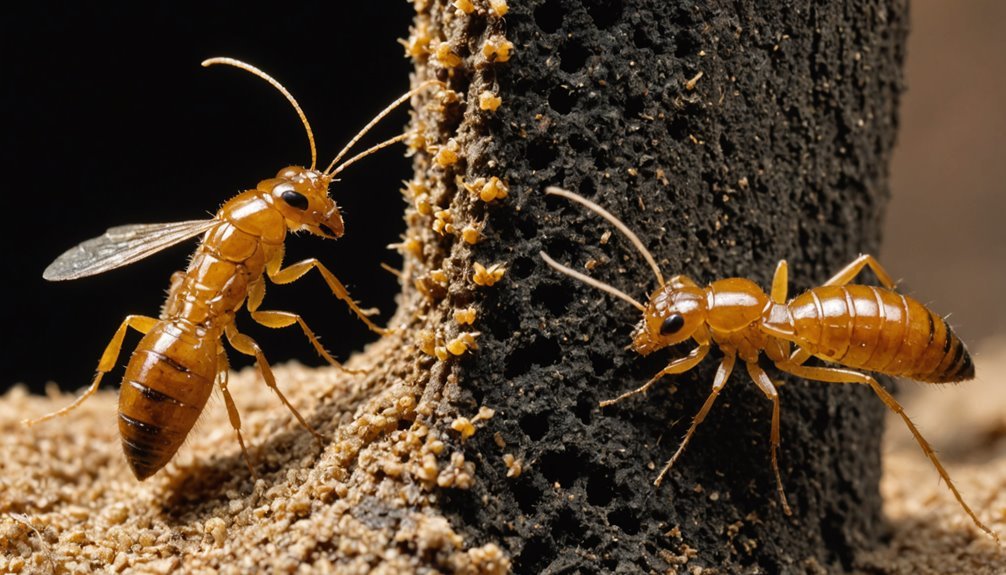
When you look at a termite’s color, you’re really seeing its job in the colony.
Workers stay pale and soft-bodied because they spend their lives hidden inside wood and tunnels, while soldiers develop dark, hardened heads built for defense.
Each caste’s appearance isn’t random—it reflects the physical demands of the role that termite fills every day. Workers make up the largest group in any termite colony, dedicating their lives to foraging, feeding nestmates, and caring for eggs.
Caste Determines Color
Although termites belong to the same colony, their color isn’t uniform—it shifts depending on their caste. Workers stay pale white or beige, soldiers keep similar body tones but develop darker, orangish heads, and reproductives darken considerably—sometimes appearing black during swarms. You can use these color differences to identify each caste without relying solely on size or shape.
| Caste | Typical Color |
|---|---|
| Workers | White or pale beige |
| Soldiers | Pale body, dark head |
| Reproductives | Light brown to black |
| Larvae | Very small, white |
When you disturb infested wood, you’ll mostly encounter pale workers, which explains the “white termite” label. Darker reproductives only become visible during swarming events, making caste-based color recognition a practical field identification tool. The queen controls caste development by emitting pheromones that regulate roles within the colony, directly influencing which color variation each termite ultimately displays.
Colony Roles Affect Appearance
Each termite’s color ties directly to its role in the colony. Workers stay pale and soft-bodied because they spend their lives inside wood galleries and nest tunnels, never exposed to the outside world.
Soldiers carry that same pale body but develop darker, hardened heads built purely for defense. Reproductives, including swarmers and the king, display darker brown or black coloring that reflects their need to move outside the colony during dispersal.
When you spot termites in damaged wood, you’re most likely seeing workers. Near mud tubes or broken entry points, you’ll notice the dark-headed soldiers.
During a swarm, the winged reproductives are the darker ones flying in search of new nesting sites. Color isn’t random — it’s functional.
What Finding White Termites in Your Home Really Means
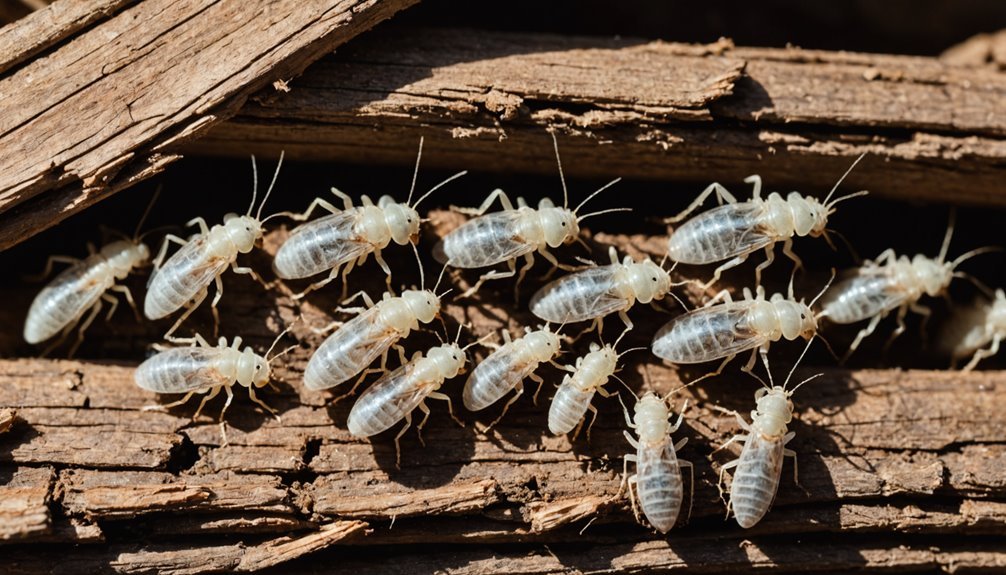
Finding white termites in your home isn’t something to dismiss as a minor oddity. Their presence signals active termite activity nearby or already inside your structure. Worker and soldier termites don’t wander randomly — they’re where the colony needs them.
A single sighting often means far more is happening behind your walls than you can see. The location matters too:
- Termites near your foundation or crawl space mean subterranean access routes may already exist beneath your feet.
- Termites inside wooden framing suggest concealed damage that’s quietly worsening every day.
- Termites spotted in multiple rooms mean the infestation has likely advanced well beyond one isolated entry point.
Don’t wait for repeated sightings. One live termite indoors is enough to schedule a professional inspection immediately.
Damage Signs White Termites Leave Behind
When you tap on wood in your home and hear a hollow sound, that’s often your first clue that termites have been feeding from the inside out.
You’ll also want to check along your foundation and walls for mud tubes, since these pencil-thin tunnels signal active subterranean termite movement.
If you’re spotting small piles of discarded wings near windows or doors, a swarm has likely already happened and a colony may be establishing itself nearby.
Hollow Wood Sounds
One of the most telling damage signs white termites leave behind is hollow-sounding wood. When you tap on baseboards, door frames, or floorboards and hear a papery, empty resonance instead of a solid knock, termites have likely eaten the interior while leaving the outer shell intact.
Compare the sound against nearby undamaged wood — the difference is striking.
Here’s why this matters to you:
- That hollow tap means structural support you’re counting on may already be gone.
- Your home can look completely normal while the inside is silently collapsing.
- One hollow spot is a warning, but multiple spots signal widespread damage throughout your home.
Don’t treat hollow sound as a minor curiosity — treat it as your signal to call a professional immediately.
Mud Tube Presence
Hollow-sounding wood tells you something is wrong beneath the surface, but mud tubes tell you exactly how termites are getting there. These pencil-sized, brown, dirt-like lines appear on foundations, walls, crawl spaces, and baseboards, connecting underground colonies directly to your wood.
Termites build them from soil, wood particles, and saliva to stay protected from air and light while they travel.
Finding a mud tube means termites have likely established a repeated pathway into structural wood. To test for activity, break a small section and check back within a few days. If it’s repaired, the colony’s still active.
If termites emerge when disturbed, you’ve got a live infestation. Don’t rely on visual clues alone — get a professional inspection to confirm what’s actually happening inside your walls.
Discarded Wings Found
Scattered wings near a windowsill or doorway are one of the strongest signs that a mature termite colony is nearby. Swarmers shed their wings after leaving the nest, so finding piles indoors means termites have already been active in or around your structure.
Wings collected near light fixtures, foundation vents, or entry points help you pinpoint where swarmers entered or exited.
Watch for these urgent warning signs alongside discarded wings:
- Hollow-sounding timber when you tap walls or floors
- Bubbling or peeling paint hiding hollowed wood beneath
- Frass piles resembling sawdust near baseboards or wooden structures
If you’re seeing wings combined with any of these damage signs, your risk of an active infestation increases considerably.
Don’t wait—get a professional inspection immediately.
How to Confirm You Have an Active White Termite Infestation
Confirming an active white termite infestation means looking beyond surface-level suspicion and gathering concrete evidence.
Start by breaking a small section of any mud tube you find. If termites repair it within a few days, you’re dealing with a live colony.
Break a mud tube and watch. If termites patch it within days, the colony is very much alive.
Next, probe suspicious wood with a screwdriver. Wood that crumbles easily, sounds hollow, or collapses under light pressure signals active feeding.
Look for creamy-white, soft-bodied termites inside damaged wood or broken tubes. Fresh frass accumulation near baseboards or door frames also points to ongoing activity rather than old damage.
Active mud tubes feel moist and soft, while dry, brittle tubes suggest past activity.
Combine multiple signs rather than relying on a single clue to confirm a current infestation.
Treating White Termites: Professional Inspection vs DIY
Once you’ve confirmed an active white termite infestation, the next decision is whether to treat it yourself or call a professional—and the answer depends largely on where the infestation is and how far it’s spread.
DIY works only when the colony is isolated, visible, and in non-structural wood like a fence post or outdoor furniture. The moment framing, sill plates, or wall voids are involved, you need a professional.
Here’s what’s at stake when you delay professional treatment:
- DIY sprays kill surface termites but leave the hidden colony feeding.
- Partial treatment can mask serious damage for 12–24 months.
- Professionals carry termiticide back to the colony, eliminating it entirely.
Don’t let a surface fix give you false confidence.
Frequently Asked Questions
Can White Termites Survive Outdoors Without an Established Colony Nearby?
You’ll find that white termites can’t survive outdoors without a nearby colony. They’re workers that need moisture, food, and colony support to live, so they’ll die quickly when exposed alone outside.
Do White Termites Cause Allergic Reactions or Health Problems in Humans?
Yes, white termites can trigger allergic reactions in you, causing rashes, itching, sneezing, or wheezing. You’re most at risk from their dust, frass, and droppings, especially if you’ve got asthma or existing allergies.
How Long Does a Typical Termite Colony Live Before Naturally Dying Off?
You’re looking at decades of survival, as a typical termite colony can live 20 to 100 years. It’ll naturally die off only after the queen dies and no replacement reproductive successfully takes over.
Are Certain Climates or Regions More Prone to White Termite Infestations?
Yes, you’ll find higher “white termite” activity in warm, humid regions like the Southern U.S. and coastal areas. These climates support moisture-dependent subterranean colonies, making infestations more likely where wet soils and mild winters exist.
Can Pets Detect White Termites Inside Walls Before Humans Notice Them?
Your pet can detect white termites inside walls before you notice them. Dogs have 220 million olfactory receptors, letting them smell and hear faint termite activity you’d likely miss entirely.
Conclusion
Whether you’re dealing with white termites or darker ones, you’re facing the same destructive pest. Don’t let their pale appearance fool you into thinking they’re less of a threat. If you’ve spotted these tiny insects in your home, you need to act fast. Contact a licensed pest control professional immediately, because the longer you wait, the more structural damage you’re risking to your property.